

LIFEPAK CR2 part numbers and shelf life
The CR2 has 2 replaceable parts, the QUIK-STEP electrode tray and the lithium battery. Here are Stryker's catalog numbers and shelf lives for both.
| Part | Part number | Shelf life | Replace |
|---|---|---|---|
| QUIK-STEP electrodes Adults and children (Child Mode), in a pre-connected tray | 11101-000021 | 4 years | By the Use By date, once the tray is opened, or if the seal is broken |
| LIFEPAK CR2 lithium battery Battery (non-rechargeable) | 11141-000165 | 4 years installed (install within 1 year of manufacture); 5 years from manufacture at most | 4 years after installation or 5 years after manufacture, whichever comes first, or when the readiness light stops flashing |
Storage affects both parts. Stryker says to keep the CR2 between 59 and 95°F (15 and 35°C), and long-term storage near the top of that range shortens battery and electrode life. The AED and pads can ride out temperatures as low as -22°F (-30°C) or as high as 140°F (60°C) for up to a week; longer than that cuts the electrodes' shelf life.
Need replacements? Total AEDs, AED Log’s sister store, sells pads, batteries and the AED itself for the LIFEPAK CR2. Any authorized distributor works; the FDA advises buying AED accessories only from authorized sources.
LIFEPAK CR2 self-test and status indicator
The LIFEPAK CR2 tests itself daily, weekly and monthly, and each time it's turned on. A green light flashing every 6 seconds means it's ready; no flash and a tone every 15 minutes mean it needs attention.
Besides the daily, weekly and monthly tests, the CR2 checks its internal electronics every time it's switched on. Fitting a new battery also starts a self-test that can take up to 2 minutes and ends with 3 tones; keep the lid closed until you hear them. The readiness light shows through a small hole in the lid. It flashes green every 6 seconds when the AED is ready and stays lit while the AED is on.
If the CR2 needs attention, the light goes dark and the AED beeps an alert every 15 minutes. The alert is on by default, though an owner can switch it off. To find out what's wrong, open the lid, wait for the voice prompts, then within 10 seconds hold LANGUAGE and CHILD MODE together. The AED answers DEVICE READY or DEVICE NOT READY and says whether to replace the tray, replace the battery or call for service. Connected units report a failed self-test right away.
If the indicator ever shows a problem, our guide to AED self-test failures and status lights covers what to do first.
LIFEPAK CR2 maintenance checklist
Stryker asks owners to confirm the CR2 is ready at least once a month, by looking at the readiness light or, for connected units, through its online program manager. Check the electrode and battery dates and the lid at the same time.
- The readiness light flashes green every 6 seconds, and no alert tone is sounding.
- The QUIK-STEP tray is sealed, its red handle hasn't been pulled, and its Use By date hasn't passed.
- The battery is within 4 years of installation and 5 years of its manufacture date.
- The lid is on and closed, with its magnet in place.
- Connected units: LIFELINKcentral shows the AED checked in this month with no failed self-test.
- The AED is stored between 59 and 95°F (15 and 35°C), and the case is clean and undamaged.
After the LIFEPAK CR2 is used
- Turn the AED off and clean it.
- Fit a new QUIK-STEP electrode tray, even if the pads weren't used.
- Close the lid and confirm the readiness light flashes every 6 seconds.
Print our free AED inspection checklist to record each check, or read the full AED maintenance guide.
LIFEPAK CR2 recalls
The FDA's recall database shows 2 recalls of the LIFEPAK CR2 itself: a 2021 notice about missing lid magnets draining the battery, and a 2025 notice about units Stryker had serviced. Both were still open when we checked.
| Date | Product | Class | What it’s about and what to do | Status | FDA record |
|---|---|---|---|---|---|
| Jul 22, 2025 | LIFEPAK 1000 and CR2 units serviced August 2022 to October 2023 | II | Service records lacked evidence of the inspection. Return Stryker’s reply form. | Open | Z-2498-2025, Z-2499-2025 |
| Jan 14, 2021 | LIFEPAK CR2 | II | A missing lid magnet can drain the battery. Check that the readiness light flashes every 6 seconds. | Open | Z-1189-2021 |
Every AED recall, by manufacturer, is on our AED recall list.
How AED Log tracks the LIFEPAK CR2
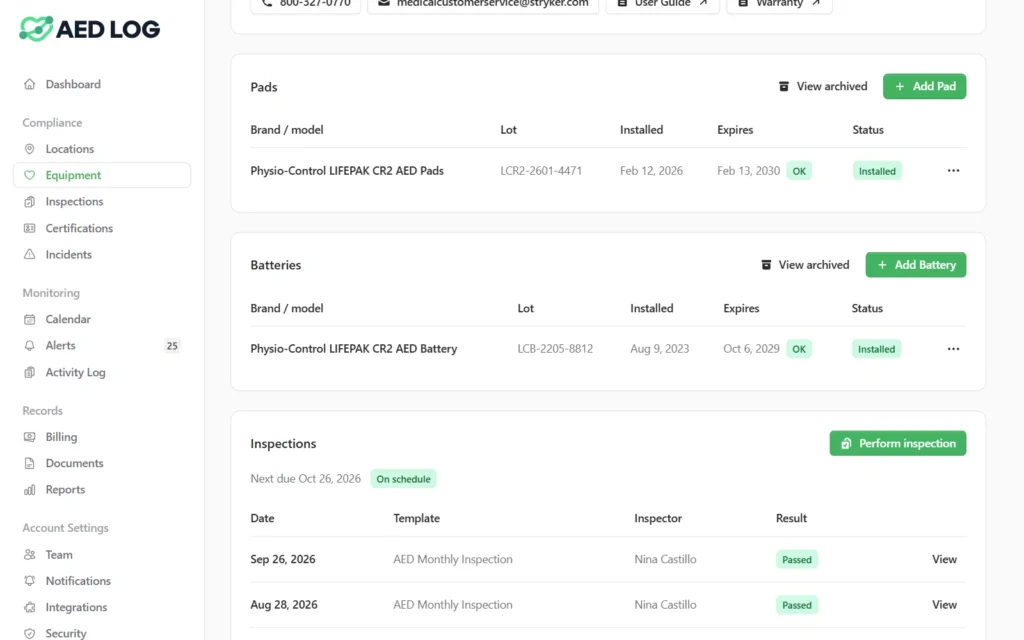
In AED Log you pick the LIFEPAK CR2 from the built-in catalog, record its pads and battery with their lot numbers and dates, and get a warning before either expires, plus a monthly inspection reminder.
Each pad set and battery is its own record with its own expiration date, so a pad set or battery never lapses unnoticed. Choose the part from the catalog and its shelf life fills in the expiration date for you; you can always type the date printed on the package instead. Alerts go out by email, Slack, Teams or Discord to the people responsible for that site, and the monthly inspection checklist asks about the status indicator, the pads and the battery. See pad and battery expiration tracking and AED management for more, or see every AED model.
LIFEPAK CR2 FAQ
How long do LIFEPAK CR2 pads last?
Stryker gives the QUIK-STEP electrode tray (11101-000021) a 4-year shelf life. The same tray serves adults and children. Replace it by the Use By date printed next to the hourglass symbol, once it has been opened, or if its seal is broken.
How long does the LIFEPAK CR2 battery last?
The LIFEPAK CR2 lithium battery (11141-000165) lasts up to 4 years after installation if it's installed within 1 year of manufacture, and never more than 5 years from manufacture. Replace it sooner if the readiness light stops flashing.
Can you use the LIFEPAK CR2 on a child?
Yes, for children 1 year and older. For a child under 8 or under 55 lb (25 kg), press the CHILD MODE button; the AED lowers its energy and switches to child CPR prompts, using the same QUIK-STEP pads. It isn't for infants under 1.
What battery does the LIFEPAK CR2 take?
The LIFEPAK CR2 lithium battery, Stryker catalog number 11141-000165. It's non-rechargeable, gives about 166 shocks at 200 joules when new, and should be installed within 1 year of its manufacture date.