
Cities and counties
Public Access Defibrillator Programs for Cities, Counties and Agencies
A public access defibrillator program puts AEDs in city halls, libraries, parks, rec centers and patrol cars, and every one has to stay ready. AED Log tracks each AED's inspections, pads, batteries and uses across every department, with access limited by site.
45 days free. No credit card required. Then plans from $114 a year.
Do cities and counties need public access AEDs?
Some state laws require AEDs in specific public places, and the AED law data in AED Log lists 41 states that require AEDs at specified locations. Many cities and counties also place AEDs in public buildings, parks and vehicles on their own.
What state law asks of an AED owner
Once a city places AEDs, state law can set the rules for them. The same data lists 24 states with AED placement reporting rules, 27 that require notifying agencies, 15 that require reporting an AED's use and 9 that require physician medical direction. See AED laws by state.
Why public access matters
OSHA notes that the chance of surviving sudden cardiac arrest drops by 7 to 10 percent for every minute without CPR or defibrillation. An AED in a public building lets a bystander act in the minutes before EMS arrives.
What a compliant public access AED program includes
A public access defibrillation program is a set of AEDs, people and procedures: devices placed where the public gathers, responders trained to use them, regular inspections and coordination with EMS.

AEDs in buildings, parks and vehicles where people gather
A program coordinator and a site contact for each building
Monthly inspections, recorded for every unit
Registration and placement reporting where state law requires it
Physician medical direction in the states that require it
An incident report and a post-use check after every use
Public AEDs get used, moved and sometimes taken. A record of where each one is, who checked it last and when it was last used keeps the program trustworthy, for residents and for the council that funds it.
How AED Log handles municipal AED programs
AED Log treats every building, park and vehicle as a location with its own AEDs, contacts and inspection schedule, all in one account.
Inspections by the people on site
Library staff, rec center managers and officers scan an AED's QR label and record its monthly check on any phone. A failed check opens a corrective action and alerts the people responsible.
Missing and used AEDs
Mark an AED Missing and it raises a critical alert. After a use, record an incident report with the EMS times and the outcome, then the post-use inspection.
AEDs in vehicles
Add each patrol car or fleet vehicle that carries an AED as a location. The vehicle add-on, $10 per vehicle per year, also tracks the vehicle's own service by mileage, registration and insurance.
Medical direction where it's required
In states that require physician medical direction, add it for $65 per AED per year, and the physician's letter is filed on each AED. Medical direction

Many departments, many buildings
Locations are unlimited, so a city or county pays one price for the number of AEDs in its tier, however many departments share them.
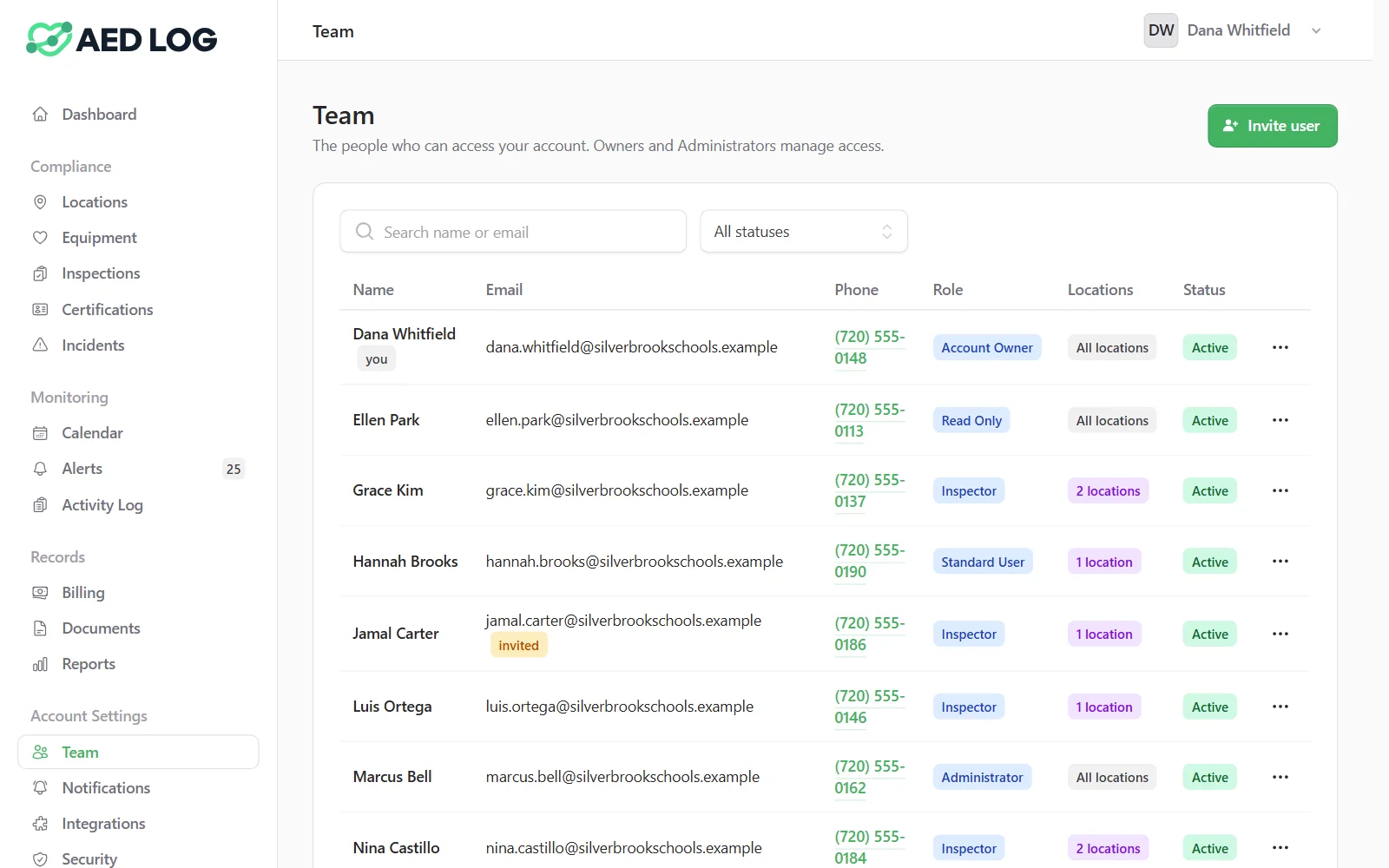
Give each department its own locations and limit its staff to them: parks staff see the parks, the police department sees its vehicles. City or county safety staff see everything on one dashboard, and reports filter by department or site.
Related guides and templates
These guides and free templates cover how to plan, place and run a public access AED program.
AED program management guide How to start an AED program AED placement guide Printable AED sign AED inspection checklist (free PDF)
Public access AED program FAQ
Run your public access AED program in one place
Every building, park and vehicle, with inspections, incident reports and access by site.
45 days free. No credit card required. Then plans from $114 a year.