
Workplaces
AED Program Management for Workplaces and Offices
An AED in the workplace only helps if it works the day someone collapses. AED Log keeps every office AED inspected, its pads and battery in date and its responders trained, with dated records an auditor can read.
45 days free. No credit card required. Then plans from $114 a year.
Do workplaces need an AED?
Not under federal law: OSHA's standards don't specifically address AEDs, although OSHA encourages employers to install them. Some states require AEDs in certain workplaces, so check your state's AED law too.
What OSHA says
OSHA's AED guidance explains why it encourages them: the chance of surviving sudden cardiac arrest falls by 7 to 10 percent for every minute without CPR or defibrillation. Its guide for employers suggests placing AEDs so they can be used within 3 to 5 minutes. The first aid standard, 29 CFR 1910.151, requires adequate first aid supplies but doesn't list an AED among them.
What state laws add
State AED laws go further. The AED law data in AED Log lists 41 states that require AEDs at specified locations and 34 that require owners to properly inspect and maintain their AEDs. So once your workplace has an AED, your state's law may set rules for its upkeep, training and reporting. See AED laws by state.
Why most workplaces have one anyway
Employees, visitors and contractors spend most of their waking hours at work, and an ambulance takes longer to arrive than an AED down the hall. That is why insurers, landlords and safety committees ask about AEDs, and why the full legal answer lives on our OSHA AED requirements page.
What a compliant workplace AED program includes
A workplace AED program is more than the device. It is the people, the checks and the records that keep each AED ready for the day it's needed.

AEDs placed so a responder can bring one to anyone within 3 to 5 minutes
A named program coordinator, plus trained responders at each site
A monthly inspection of every AED, written down and dated
Pads and batteries replaced before their expiration dates
CPR and AED certifications renewed before they lapse
An incident report and a post-use check after every use
Some states also require a medical director, registration with local EMS or written program documentation. Records matter as much as the checks themselves: an inspection that isn't written down can't be shown to an auditor, an insurer or an investigator after a rescue.
How AED Log handles workplace AED programs
AED Log schedules every inspection, tracks every expiration and keeps every record in one place, so the program doesn't depend on one person's memory or one person's spreadsheet.
Monthly inspections on any phone
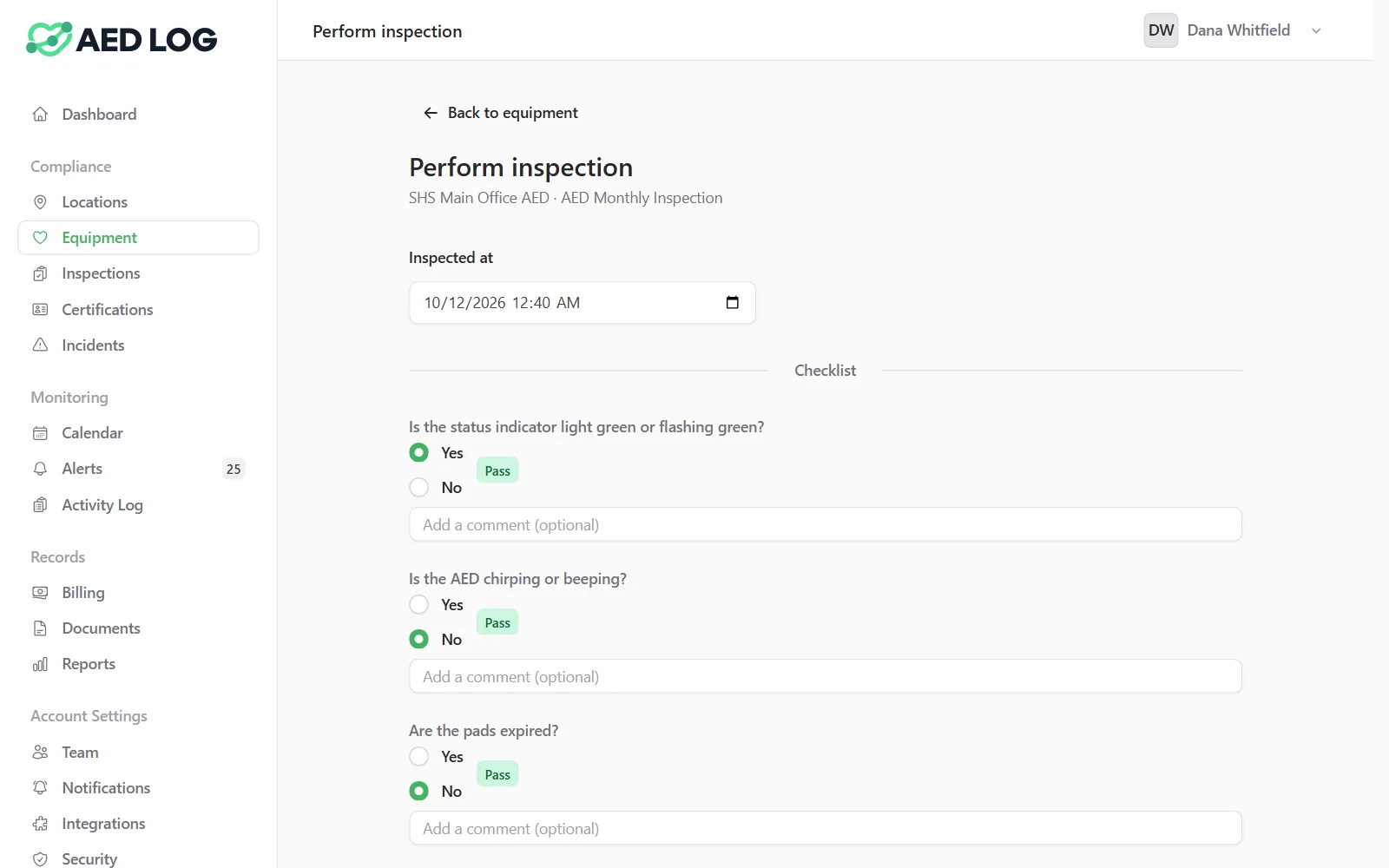
Inspectors scan the AED's QR label or pick it from the list and answer the monthly checklist in the browser, with nothing to install. A failed check opens a corrective action and marks the AED not safe to use until it's fixed.
Pads, batteries and certifications
Every pad and battery carries its expiration date, and so does every responder's CPR and AED card. Alerts reach the responsible people 90 days ahead, by email or in Slack, Microsoft Teams or Discord.
Records an auditor can read
Inspection history, the expiration forecast and the audit trail download as a CSV or a branded PDF, filtered by building or date. Every download is recorded in the activity log.
Beyond the AED
Track first aid cabinets, eyewash stations and fire extinguishers on the same system as add-ons, each with its own checklist and schedule. See every equipment type.

Offices in more than one building or city
Locations are unlimited on every plan, so a company with offices in several cities pays only for the number of AEDs in its tier.
Give each office a site contact and limit its managers to their own buildings: their dashboard, alerts, calendar and reports follow. Head office sees every site on one dashboard, with a needs-attention list that puts expired pads and overdue checks at the top.
Related guides and templates
These guides and free templates cover the details of a workplace AED program, from the legal answer to the monthly checklist.
OSHA AED requirements OSHA emergency action plan template AED inspection checklist AED placement guide AED inspection log sheet (free PDF) First aid kit requirements
Workplace AED program FAQ
Run your workplace AED program in one place
Inspections, expirations and certifications for every office, with records ready for an audit.
45 days free. No credit card required. Then plans from $114 a year.