

LIFEPAK 1000 part numbers and shelf life
These are the parts a LIFEPAK 1000 owner replaces, with Stryker's catalog numbers. For both pads Stryker states only a minimum shelf life at shipment, not a full one.
| Part | Part number | Shelf life | Replace |
|---|---|---|---|
| EDGE System electrodes with QUIK-COMBO connector and REDI-PAK preconnect system Adult pads | 11996-000017 | Not stated by Stryker (at least 18 months left when shipped) | By the Use By date on the packet, after use, after 50 shocks, or after 24 hours out of the foil |
| Infant/Child Reduced Energy Defibrillation Electrodes Children under 8 or under 55 lb (starter kit 11101-000017) | 11101-000016 | Not stated by Stryker (at least 18 months left when shipped) | By the Use By date, or after any use |
| LIFEPAK 1000 lithium battery Battery (non-rechargeable lithium manganese dioxide) | 11141-000100 | 5 years in standby once installed; up to 5 years on the shelf before that | By the Use By date, when the fuel gauge shows 1 light, or when the AED shows a low battery |
The app catalog's generic "Battery" entry for the LIFEPAK 1000 is this lithium battery. Stryker's battery instructions also cover a second number, 11141-000156, without saying how it differs from 11141-000100.
Need replacements? Total AEDs, AED Log’s sister store, sells pads, batteries and the AED itself for the LIFEPAK 1000. Any authorized distributor works; the FDA advises buying AED accessories only from authorized sources.
LIFEPAK 1000 self-test and status indicator
The LIFEPAK 1000 tests itself every day and every month at 3:00 a.m., and again each time it's turned on. An OK symbol on the readiness display means it's ready; a wrench symbol or a low or empty battery symbol means it needs attention.
The 3:00 a.m. daily and monthly tests run only while the AED isn't in use. Each time it's switched on, it also spends about 5 seconds checking its internal electrical parts and circuits, and it saves the results in a test log. The small readiness display stays visible while the AED is off. If a self-test finds a fault that needs service, the OK symbol disappears and a wrench symbol takes its place.
If a fault turns up while the AED is on, it gives the prompt CALL SERVICE. Stryker says to keep using it in an emergency anyway and have it serviced afterward. The data sheet also lists an optional service alert, a sound the AED makes when it needs servicing.
If the indicator ever shows a problem, our guide to AED self-test failures and status lights covers what to do first.
LIFEPAK 1000 maintenance checklist
Stryker says to inspect the LIFEPAK 1000 on a regular schedule, and weekly if it's rarely used: the OK symbol, the battery level, the pad Use By date and the supplies. Inspect and clean it after every use, too.
- The readiness display shows the OK symbol, with no wrench and no low or empty battery symbol.
- The battery's fuel gauge shows more than 1 light, and the battery's Use By date hasn't passed.
- The adult pad packet is sealed and within its Use By date.
- Any Infant/Child Reduced Energy electrodes kept with the AED are sealed, in date and not from a recalled lot.
- Pads and the other supplies and accessories you need are with the AED.
- The AED is stored between 59 and 95°F (15 and 35°C).
After the LIFEPAK 1000 is used
- Inspect the AED for damage.
- Clean it.
- Check that pads and all the other supplies and accessories are back with the AED.
Print our free AED inspection checklist to record each check, or read the full AED maintenance guide.
LIFEPAK 1000 recalls
The FDA's recall database lists LIFEPAK 1000 recalls from 2014, 2017 (Class I, for units that could switch off during use), 2025 and 2026, plus recalls of its infant/child electrodes. The 2025 and 2026 service-record recalls and a 2026 electrode recall were still open when we checked.
| Date | Product | Class | What it’s about and what to do | Status | FDA record |
|---|---|---|---|---|---|
| Apr 13, 2026 | LIFEPAK 1000 units serviced July 2023 to November 2025 | II | No record that a post-service inspection was done. Return Stryker’s reply form and keep up daily checks. | Open | Z-2065-2026 |
| Jan 21, 2026 | Infant/child reduced-energy electrodes 11101-000016 and -017 | II | Electrode gel can separate from the pad. Stop using and set aside affected electrodes; Stryker replaces them. | Open | Z-1544-2026 |
| Jul 22, 2025 | LIFEPAK 1000 and CR2 units serviced August 2022 to October 2023 | II | Service records lacked evidence of the inspection. Return Stryker’s reply form. | Open | Z-2498-2025, Z-2499-2025 |
| Apr 24, 2020 | Infant/child electrodes 3202380-006 | II | Packaging not properly sealed. | Closed 2023 | Z-2359-2020 |
| Oct 27, 2017 | Infant/child electrodes 11101-000016 | I | Artwork showed the wrong infant pad placement. | Closed 2019 | Z-0186-2018 |
| Jan 13, 2017 | LIFEPAK 1000 | I | Can power off unexpectedly during use. | Closed 2019 | Z-1257-2017 |
| May 9, 2014 | LIFEPAK 1000 (part numbers 320371500XXX) | II | Some units shut down during use when the battery ran very low, which could stop a shock. Owners got new readiness-check instructions and replacement batteries where needed. | Closed 2018 | Z-1660-2014 |
Every AED recall, by manufacturer, is on our AED recall list.
How AED Log tracks the LIFEPAK 1000
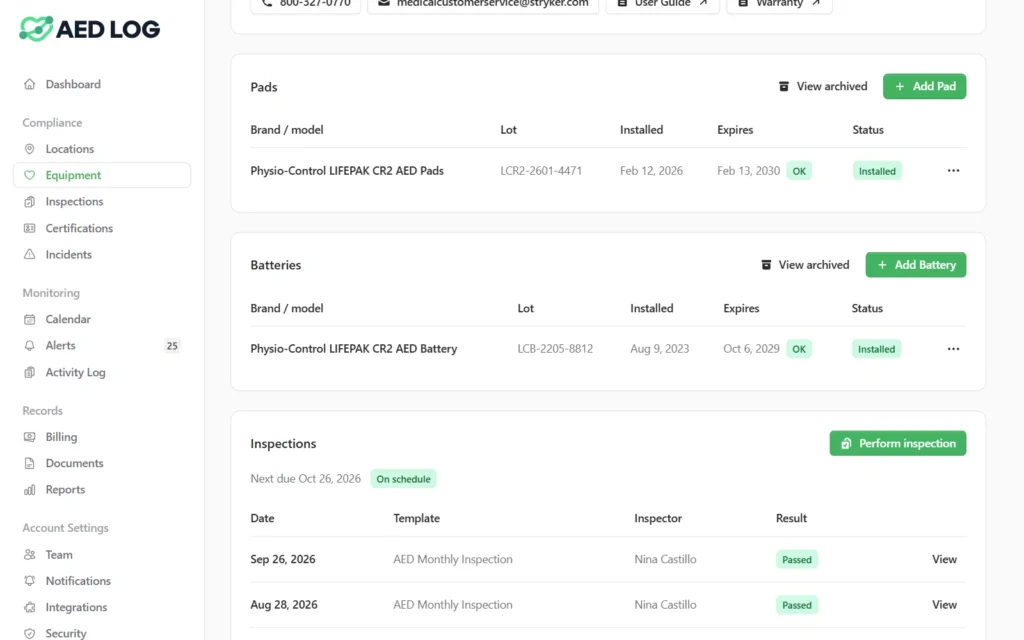
In AED Log you pick the LIFEPAK 1000 from the built-in catalog, record its pads and battery with their lot numbers and dates, and get a warning before either expires, plus a monthly inspection reminder.
Each pad set and battery is its own record with its own expiration date, so a pad set or battery never lapses unnoticed. Choose the part from the catalog and its shelf life fills in the expiration date for you; you can always type the date printed on the package instead. Alerts go out by email, Slack, Teams or Discord to the people responsible for that site, and the monthly inspection checklist asks about the status indicator, the pads and the battery. See pad and battery expiration tracking and AED management for more, or see every AED model.
LIFEPAK 1000 FAQ
How long do LIFEPAK 1000 pads last?
Stryker doesn't publish a full shelf life for LIFEPAK 1000 pads. It promises at least 18 months left when the adult pads (11996-000017) or child electrodes (11101-000016) ship, so go by the Use By date on the packet, and replace them after use.
How long does the LIFEPAK 1000 battery last?
Installed in a LIFEPAK 1000 that isn't used, the lithium battery (11141-000100) lasts 5 years in standby. Replace it by its Use By date, or sooner if its fuel gauge shows 1 light or the AED shows a low battery symbol.
Can you use the LIFEPAK 1000 on a child?
Yes. For a child under 8 or under 55 lb (25 kg), plug Infant/Child Reduced Energy Defibrillation Electrodes (11101-000016) straight into the AED. Don't use Pediatric QUIK-COMBO electrodes; Stryker warns they don't lower its energy.
What battery does the LIFEPAK 1000 take?
A non-rechargeable lithium manganese dioxide battery, Stryker catalog number 11141-000100. The 2008 manual lists it as 21300-006054. A new one gives about 440 shocks at 200 joules and lasts 5 years in standby.