
AED model

LIFEPAK CR Plus and EXPRESS: Pads, Battery and Maintenance

Kyle Nowack, Co-founder of AED Log

By Kyle Nowack

Co-founder, AED Log

Last reviewed October 13, 2026 · 8 min read

Last reviewed against Stryker’s own manuals and product pages. Always follow the manual that came with your AED and the dates printed on your own pads and battery.

The short answer

The LIFEPAK CR Plus and EXPRESS use QUIK-PAK adult pads that come only in kits with a CHARGE-PAK battery charger, and Stryker says to replace both together about every 2 years. Children under 8 use Infant/Child Reduced Energy electrodes (11101-000016). OK on the readiness display means ready. Stryker stopped selling both in the US in 2019.

Key facts

  • Adult pads: QUIK-PAK electrodes, listed only with a CHARGE-PAK, in kit 11403-000001 (2 pad sets) or 11403-000002 (1 pad set).
  • Replace pads and CHARGE-PAK together: after any use, when the CHARGE-PAK symbol appears, or by the Use By date, typically 2 years.
  • The CHARGE-PAK is a charger that keeps the AED's internal rechargeable battery topped up; it isn't the main battery.
  • Child pads: Infant/Child Reduced Energy Defibrillation Electrodes (11101-000016) for children under 8 or under 55 lb (25 kg).
  • US sales ended November 27, 2019. On October 13, 2026, Stryker's online store listed no CHARGE-PAK kits or adult pads for the CR Plus.

LIFEPAK CR Plus at a glance

The LIFEPAK CR Plus and LIFEPAK EXPRESS are public-access AEDs made by Physio-Control, now part of Stryker. Stryker stopped selling both in the US on November 27, 2019 and named the LIFEPAK CR2 as the CR Plus's successor.

LIFEPAK CR Plus and EXPRESS at a glance, from Stryker’s documents.
DetailLIFEPAK CR Plus
Made byPhysio-Control (now part of Stryker)
VersionsCR Plus fully or semi-automatic; EXPRESS semi-automatic only
Adult padsQUIK-PAK, replaced with the CHARGE-PAK about every 2 years
ChildrenInfant/Child Reduced Energy Defibrillation Electrodes
BatteryInternal rechargeable battery, kept charged by a CHARGE-PAK
Self-testAutomatic; Stryker's available documents don't give the schedule
Ready indicatorOK on the readiness display
Storage range59 to 95°F (15 to 35°C) long term
FDA approvalDecember 21, 2017 (P160012)
StatusUS sales ended November 27, 2019

Pressing the button that releases the lid also switches either model on, and the pads are connected underneath, ready to use. The CR Plus weighs 4.5 lb (2.0 kg) with its CHARGE-PAK and pads and is splash-proof (IPX4). Its factory energy settings are 200, 300 and 360 joules, adjustable from 150 to 360. The FDA cleared the CR Plus in 2001 and the EXPRESS in 2003, then approved both under PMA P160012 in December 2017.

Stryker's November 2019 letter ended US sales immediately. New units bought before October 31, 2020 kept their standard warranty, and Stryker promised service, CHARGE-PAKs, electrodes, lids and carry cases for as long as each unit's warranty lasts. It hasn't published a later end-of-support date. Stryker named the LIFEPAK CR2 as the CR Plus's successor, with the HeartSine samaritan PAD 450P as another option.

LIFEPAK CR Plus and LIFEPAK EXPRESS: how they differ

  • LIFEPAK CR Plus: Sold in fully automatic and semi-automatic versions, with more shocks and operating time per charge than the EXPRESS and an 8-year warranty.
  • LIFEPAK EXPRESS: Semi-automatic only; the FDA describes it as the same AED with fewer shocks, less operating time and a different case and lid color, and it carried a 5-year warranty.

Other Stryker LIFEPAK (formerly Physio-Control) models we cover: LIFEPAK CR2, LIFEPAK 1000 and LIFEPAK 500.

LIFEPAK CR Plus pads

Both models use QUIK-PAK adult pads, already connected under the lid. Stryker lists them only inside CHARGE-PAK replacement kits, 11403-000001 or 11403-000002, and says to replace the pads every 2 years.

QUIK-PAK pads sit under the lid with their connection already made, so there's no cable to plug in. Stryker doesn't list them on their own: kit 11403-000001 holds 2 pad sets and 1 CHARGE-PAK, and kit 11403-000002 holds 1 of each. The pads and the CHARGE-PAK share a single replacement cycle. Swap both after any use, when the CHARGE-PAK symbol shows on the readiness display, or by the Use By date, which Stryker says is typically 2 years away. It doesn't say whether those 2 years count from manufacture.

The 2-year figure comes from the CR Plus data sheet. We found no separate EXPRESS data sheet, but Stryker's catalogs list the same kits for both models. On October 13, 2026, Stryker's online store page for the CR Plus showed child electrodes, cases, cabinets and trainers, but no CHARGE-PAK kits or QUIK-PAK pads.

Using the LIFEPAK CR Plus on children

Yes: a child younger than 8 or lighter than 55 pounds (25 kg) should get Infant/Child Reduced Energy Defibrillation Electrodes (11101-000016). If those aren't on hand or the child's age is unclear, Stryker says to use the adult QUIK-PAK pads.

Infant/Child Reduced Energy Defibrillation Electrodes come as a starter kit (11101-000017) and as a replacement set (11101-000016). They're the same child electrodes Stryker sells for the LIFEPAK 1000, and its catalogs list them for both the CR Plus and the EXPRESS. Stryker's store promises at least 18 months of shelf life when they ship and, on October 13, 2026, still listed them for the CR Plus.

Use them for a child younger than 8 or lighter than 55 lb (25 kg). If no child electrodes are at hand, or you can't tell how old the child is, Stryker says to go ahead with the adult QUIK-PAK pads. These child electrodes are part of an open 2026 FDA recall over gel separating from the pad, shown in the recalls section below.

For the general rules on child pads, ages and placement, see our guide to pediatric AED pads.

LIFEPAK CR Plus battery

The CR Plus and EXPRESS have a rechargeable internal battery that a replaceable CHARGE-PAK battery charger keeps topped up. The CHARGE-PAK is swapped together with the pads, typically every 2 years.

The CHARGE-PAK is a lithium sulfuryl chloride charger rated at 12 volts and 1.5 amp-hours. It isn't what powers a rescue: it keeps the AED's internal rechargeable battery charged. A fully charged CR Plus typically gives 30 full-energy shocks or 210 minutes of on time, and no fewer than 20 shocks or 140 minutes. The EXPRESS gives fewer shocks and less time, but Stryker doesn't publish its figures.

After the internal battery is fully drained, a new CHARGE-PAK kept above 59°F (15°C) restores enough charge for 6 shocks or 42 minutes within 24 hours, and 20 shocks or 140 minutes within 72 hours. Replace the CHARGE-PAK, along with the pads, after every use.

How other models compare is in our AED battery replacement guide.

LIFEPAK CR Plus part numbers and shelf life

These are the replaceable parts for both models, with Stryker's catalog numbers. The adult pads and the CHARGE-PAK share kit numbers because Stryker only lists them together.

Replacement parts for the LIFEPAK CR Plus and EXPRESS, with Stryker’s part numbers and shelf lives (checked October 13, 2026). Go by the date printed on your own parts.
PartPart numberShelf lifeReplace
QUIK-PAK electrodes
Adult pads, supplied only in CHARGE-PAK kits (11403-000001: 2 pad sets; 11403-000002: 1 pad set)
11403-000001 or 11403-000002Typically 2 years (Use By date)With the CHARGE-PAK: after any use, when the CHARGE-PAK symbol shows, or by the Use By date
CHARGE-PAK battery charger
Charges the internal battery; supplied only with QUIK-PAK pads in the same kits
11403-000001 or 11403-000002Typically 2 years (Use By date)With the pads: after any use, when the CHARGE-PAK symbol shows, or by the Use By date
Infant/Child Reduced Energy Defibrillation Electrodes
Children under 8 or under 55 lb (starter kit 11101-000017)
11101-000016Not stated by Stryker (at least 18 months left when shipped)By the Use By date, or after any use

Long-term storage for the CR Plus should stay between 59 and 95°F (15 and 35°C). For trips of up to a week, Stryker allows anything from -40°F (-40°C) up to 158°F (70°C).

LIFEPAK CR Plus self-test and status indicator

The CR Plus and EXPRESS run automatic self-tests and show the result on a readiness display, where OK means ready. The Stryker documents we could find don't give the self-test schedule.

The readiness display has 4 indicators. OK means the AED is ready for use. The CHARGE-PAK symbol means it's time for a new CHARGE-PAK, and with it new pads. The attention symbol means the charge is getting low, with at least 6 shocks or 42 minutes left. The service symbol means the AED needs servicing.

The FDA's approval summary confirms that both models run automatic self-tests. We couldn't find the CR Plus and EXPRESS operating instructions on Stryker's website, so the test schedule and any alert sounds aren't covered here; check the operating instructions that came with your AED.

If the indicator ever shows a problem, our guide to AED self-test failures and status lights covers what to do first.

LIFEPAK CR Plus maintenance checklist

Routine care for the CR Plus and EXPRESS centers on the readiness display and one shared replacement cycle: new pads and a new CHARGE-PAK go in together after a use, when the CHARGE-PAK symbol appears, or by the Use By date.

  • The readiness display shows OK, with no CHARGE-PAK, attention or service symbol.
  • The Use By date for the pads and CHARGE-PAK hasn't passed (typically 2 years after fitting).
  • A replacement CHARGE-PAK kit is on hand or on order well before that date.
  • Any Infant/Child Reduced Energy electrodes kept with the AED are sealed, in date and not from a recalled lot.
  • The lid is closed and undamaged.
  • The AED is stored between 59 and 95°F (15 and 35°C).

Print our free AED inspection checklist to record each check, or read the full AED maintenance guide.

LIFEPAK CR Plus recalls

The FDA's recall database shows recalls of the CR Plus and EXPRESS in 2013 and 2016 and 2 Class I recalls of the CR Plus in 2008 and 2009, all now closed. The only open one is a 2026 recall of the infant/child electrodes used with them.

FDA recalls that cover the LIFEPAK CR Plus or its accessories, newest first. From the FDA’s Medical Device Recall database, checked October 12, 2026.
DateProductClassWhat it’s about and what to doStatusFDA record
Jan 21, 2026Infant/child reduced-energy electrodes 11101-000016 and -017IIElectrode gel can separate from the pad. Stop using and set aside affected electrodes; Stryker replaces them.OpenZ-1544-2026
Apr 24, 2020Infant/child electrodes 3202380-006IIPackaging not properly sealed.Closed 2023Z-2359-2020
Oct 27, 2017Infant/child electrodes 11101-000016IArtwork showed the wrong infant pad placement.Closed 2019Z-0186-2018
May 25, 2016LIFEPAK CR Plus and LIFEPAK EXPRESS (listed serial numbers)IIAn internal switch could stick, so the AED might not start its voice prompts when the lid opened and couldn’t shock. Affected units had the part replaced.Closed 2018Z-2100-2016
Feb 8, 2013LIFEPAK CR Plus and LIFEPAK EXPRESSIIThe internal battery could run down early. Owners were told to check for the OK symbol and call if a wrench or attention symbol showed; affected units were replaced.Closed 2015Z-1082-2013
Jul 31, 2009LIFEPAK CR Plus (34 units)IA relay could short in very humid conditions and stop the AED reading the heart rhythm correctly, preventing a shock. Affected units were replaced.Closed 2013Z-2030-2009
Aug 28, 2008LIFEPAK CR Plus fully automatic (249 units)IUnits sold as fully automatic had semi-automatic software, so they waited for a shock button that was covered. Affected units were replaced.Closed 2013Z-2341-2008

Every AED recall, by manufacturer, is on our AED recall list.

How AED Log tracks the LIFEPAK CR Plus

In AED Log you pick the LIFEPAK CR Plus from the built-in catalog, record its pads and battery with their lot numbers and dates, and get a warning before either expires, plus a monthly inspection reminder.

Each pad set and battery is its own record with its own expiration date, so a pad set or battery never lapses unnoticed. Choose the part from the catalog and its shelf life fills in the expiration date for you; you can always type the date printed on the package instead. Alerts go out by email, Slack, Teams or Discord to the people responsible for that site, and the monthly inspection checklist asks about the status indicator, the pads and the battery. See pad and battery expiration tracking and AED management for more, or see every AED model.
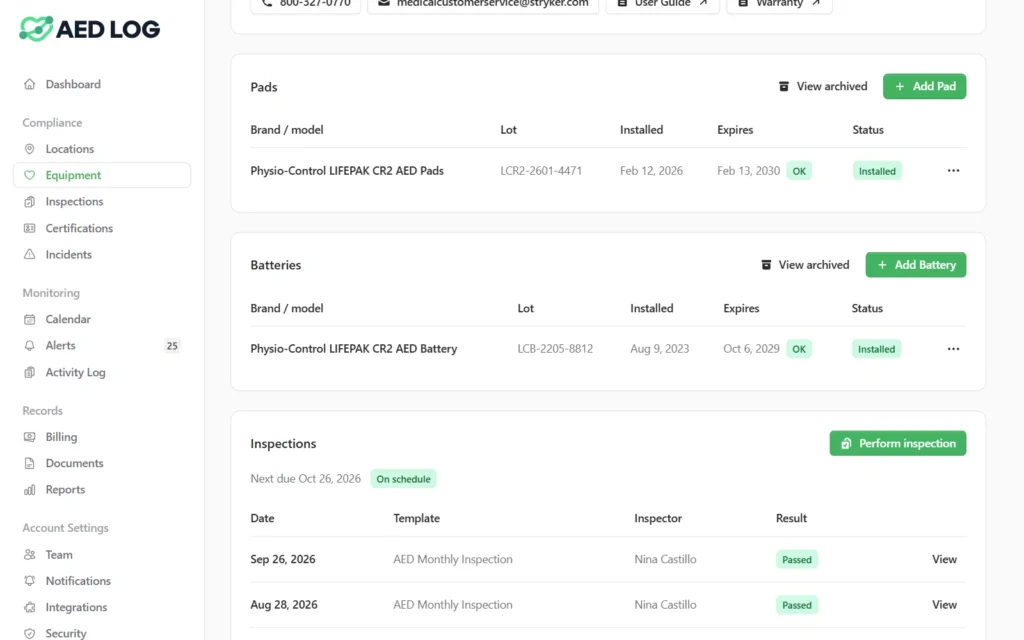
The pads and batteries on an AED in AED Log, each with its lot number, installed date, expiration date and status, above the unit's inspection schedule
An AED’s pads and batteries in AED Log, each with its lot number, installed date and expiration date.

LIFEPAK CR Plus FAQ

How long do LIFEPAK CR Plus pads last?

Stryker says to replace QUIK-PAK pads every 2 years, together with the CHARGE-PAK, or sooner after a use or when the CHARGE-PAK symbol appears. Child electrodes (11101-000016) ship with at least 18 months of shelf life left.

How long does the LIFEPAK CR Plus battery last?

The internal battery is recharged by the CHARGE-PAK, which you replace with the pads after any use, when the CHARGE-PAK symbol appears, or by its Use By date, typically 2 years. A fully charged CR Plus typically gives 30 shocks.

Can you use the LIFEPAK CR Plus on a child?

Yes. Stryker's Infant/Child Reduced Energy Defibrillation Electrodes (11101-000016) are for a child under 8 or under 55 lb (25 kg). If none are at hand or the age is unclear, Stryker says to use the adult QUIK-PAK pads.

Is the LIFEPAK CR Plus discontinued?

Yes. Stryker stopped selling the CR Plus and EXPRESS in the US on November 27, 2019. It promised service, CHARGE-PAKs and electrodes for each unit's warranty life (8 years CR Plus, 5 years EXPRESS) and named the LIFEPAK CR2 as the successor.

What is a LIFEPAK CHARGE-PAK?

A replaceable lithium charger that keeps the CR Plus or EXPRESS internal battery charged. Stryker lists it only with QUIK-PAK pads, in kit 11403-000001 (2 pad sets) or 11403-000002 (1 pad set).

Keep every AED ready

AED Log tracks inspections, pads, batteries, certifications and incidents for every AED, whatever the brand.

45 days free. No credit card required. Then plans from $114 a year.