
Daycare and childcare
AED Program Management for Daycare and Childcare Centers
AED requirements for daycare centers come from state licensing rules, and a center that keeps an AED needs child pads that are in date. AED Log tracks the AED, the first aid cabinets and every staff CPR and first aid card, with reminders before anything lapses.
45 days free. No credit card required. Then plans from $114 a year.
Do daycare centers need an AED?
It depends on your state's child care licensing rules, which are separate from its AED law and vary widely, so ask your licensing agency what applies to your center.
Where the rules come from
State AED laws rarely mention child care: in the AED law data in AED Log, no state names daycare or child care centers among the places that must have an AED. Licensing rules usually set a center's first aid and staff training requirements, so they are the place to check, along with your state's general AED law.
If you keep an AED, keep child pads with it
AEDs handle small children in one of three ways: separate infant and child pads (such as ZOLL Pedi-padz II or the HeartSine Pediatric-Pak), a key that lowers the energy (the Philips HeartStart FRx), or a child mode on the same pads (such as the ZOLL AED 3, the LIFEPAK CR2 and the Avive Connect). Manufacturers generally specify them for children under 8 years or under 55 pounds. Our AED pads guide has the details by brand.
What a compliant childcare AED program includes
A childcare AED program is built around the youngest patients: child pads or a child mode, staff trained in pediatric CPR, and a first aid cabinet that's always stocked.

An AED with in-date child pads, a child key or a child mode
Staff trained in pediatric CPR, AED use and first aid, with renewals tracked
A monthly inspection of the AED and its child pads
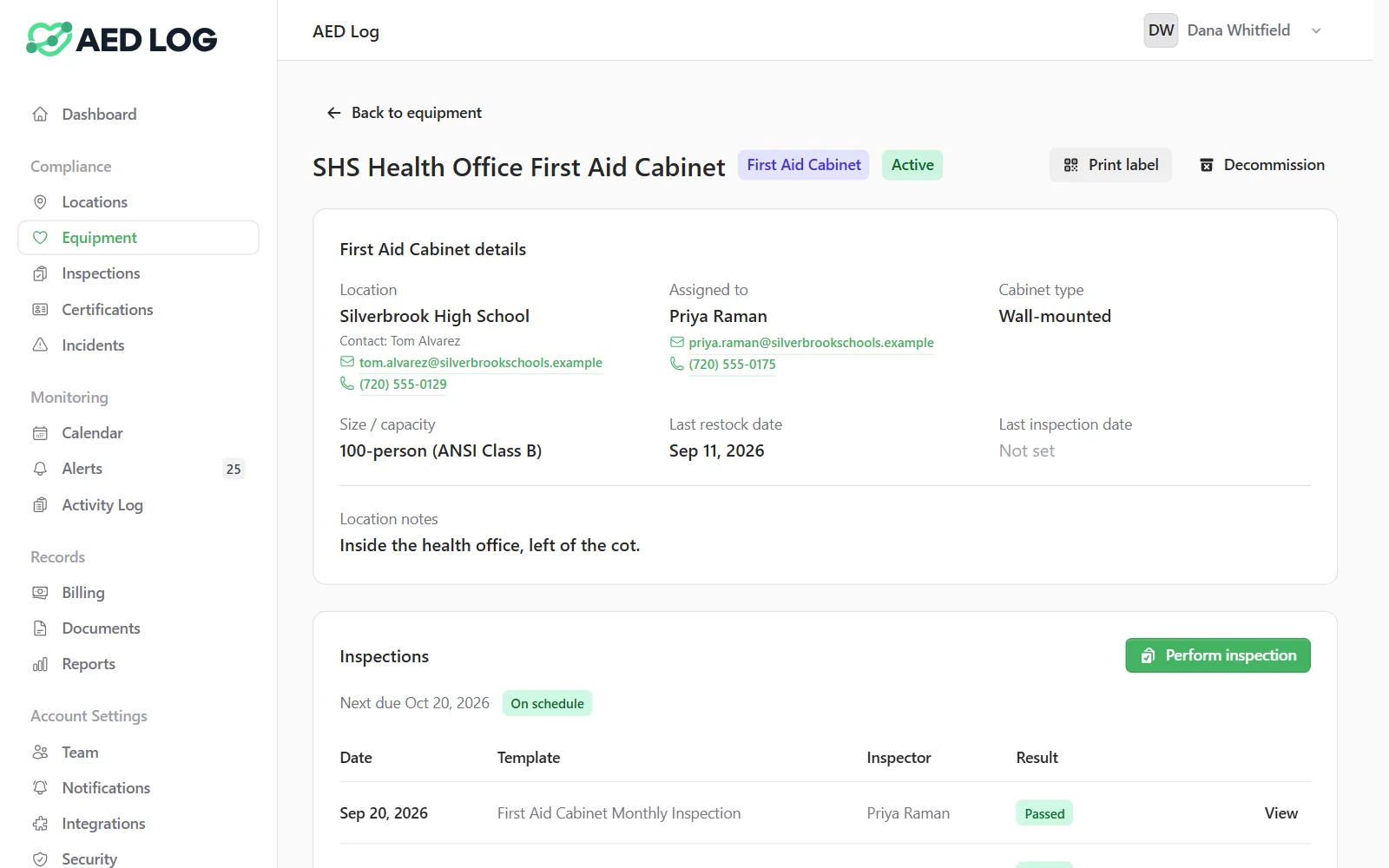
First aid cabinets checked and restocked on a schedule
EpiPens tracked by lot number and expiration date
A plan for who calls 911, who starts CPR and who stays with the other children
Separate child pads expire on their own schedule, apart from the adult pads, so they are easy to miss. Record both on the AED and check both every month.
How AED Log handles childcare AED programs
AED Log keeps every expiration date in a center, from the child pads to each teacher's CPR card, and warns the director before any of them lapses.
Child pads as their own part
Add the pediatric pads or Pediatric-Pak to the AED with their own expiration date, and AED Log warns you about them separately from the adult pads.
Pediatric certifications
The certification catalog includes pediatric courses such as Heartsaver Pediatric First Aid CPR AED, so each teacher's card is tracked with its own expiration date. Staff don't need a login to be tracked.
First aid cabinets and EpiPens
Track each first aid cabinet's supplies and their expiration dates with a monthly check, and each EpiPen by lot and expiration date. As add-ons they cost $8 per cabinet and $8 per EpiPen unit a year.
Alerts to the director
Anything expiring shows up 90 days ahead on the dashboard and in the director's email, right away or in a daily or weekly digest.

Childcare groups with several centers
Each center is a location, and locations are unlimited, so a childcare group pays one price for the number of AEDs in its tier.
Center directors see only their own center, while the group's operations team sees every center on one dashboard, with expired pads and lapsed certifications listed first.
Related guides and templates
These guides and free templates cover the pads, the first aid cabinet and the staff training in a childcare center.
AED pads guide First aid kit inspection checklist (free PDF) CPR and AED certification How to start an AED program
Daycare AED FAQ
Keep every center ready for its youngest patients
Child pads, first aid cabinets and staff certifications, with reminders before anything lapses.
45 days free. No credit card required. Then plans from $114 a year.