
Manufacturing and construction
AED Program Management for Manufacturing Plants and Construction Sites
An AED on a construction site or a plant floor shares the wall with the eyewash station, the first aid cabinet and the fire extinguisher. AED Log inspects all four on one schedule, with dated records ready for an OSHA inspector or a safety audit.
45 days free. No credit card required. Then plans from $114 a year.
Do manufacturing plants and construction sites need an AED?
OSHA doesn't require them: its standards don't specifically address AEDs. But OSHA encourages AEDs at work and names the kinds of sites where they matter most, including remote sites, confined spaces and electrical work. Check your state's AED law too.
What OSHA's AED guidance says
OSHA's guide for employers suggests placing AEDs so they can be used within 3 to 5 minutes, and lists places to consider them: areas with many workers, near confined spaces, where work is done on or near electricity, outdoors where lightning is a risk, and remote sites. For shipyards, a non-mandatory appendix to 29 CFR 1915.87 says to place AEDs for use within three to five minutes and to maintain them per the manufacturer.
Remote sites and response time
OSHA reads the "near proximity" in its first aid rule as emergency care within 3 to 4 minutes where serious injuries such as cardiac arrest are possible (OSHA letter, 2007). On a remote site, far from EMS, an AED on site is the practical way to get defibrillation inside that window. OSHA AED requirements
What a compliant plant or job-site AED program includes
A plant or job-site AED program puts the AED where crews work, trains enough people to use it on every shift, and keeps it inspected through dust, heat and cold.

AEDs reachable within 3 to 5 minutes of every work area
Trained responders on every shift and every crew
A monthly inspection of every AED, recorded and dated
Cabinets and storage that suit the site's dust, moisture and temperature
Pads and batteries replaced before they expire
A plan for directing EMS to the right gate or floor
Construction AEDs move with the job, so record each move: the next inspection should find the unit where its record says it is. Each AED maker also sets the temperature range its pads and battery can be stored in, so check it for sites without climate control.
Eyewash, first aid and fire extinguishers on the same system
OSHA has specific rules for all three, and AED Log tracks each of them as an add-on with its own checklist, next to your AEDs.
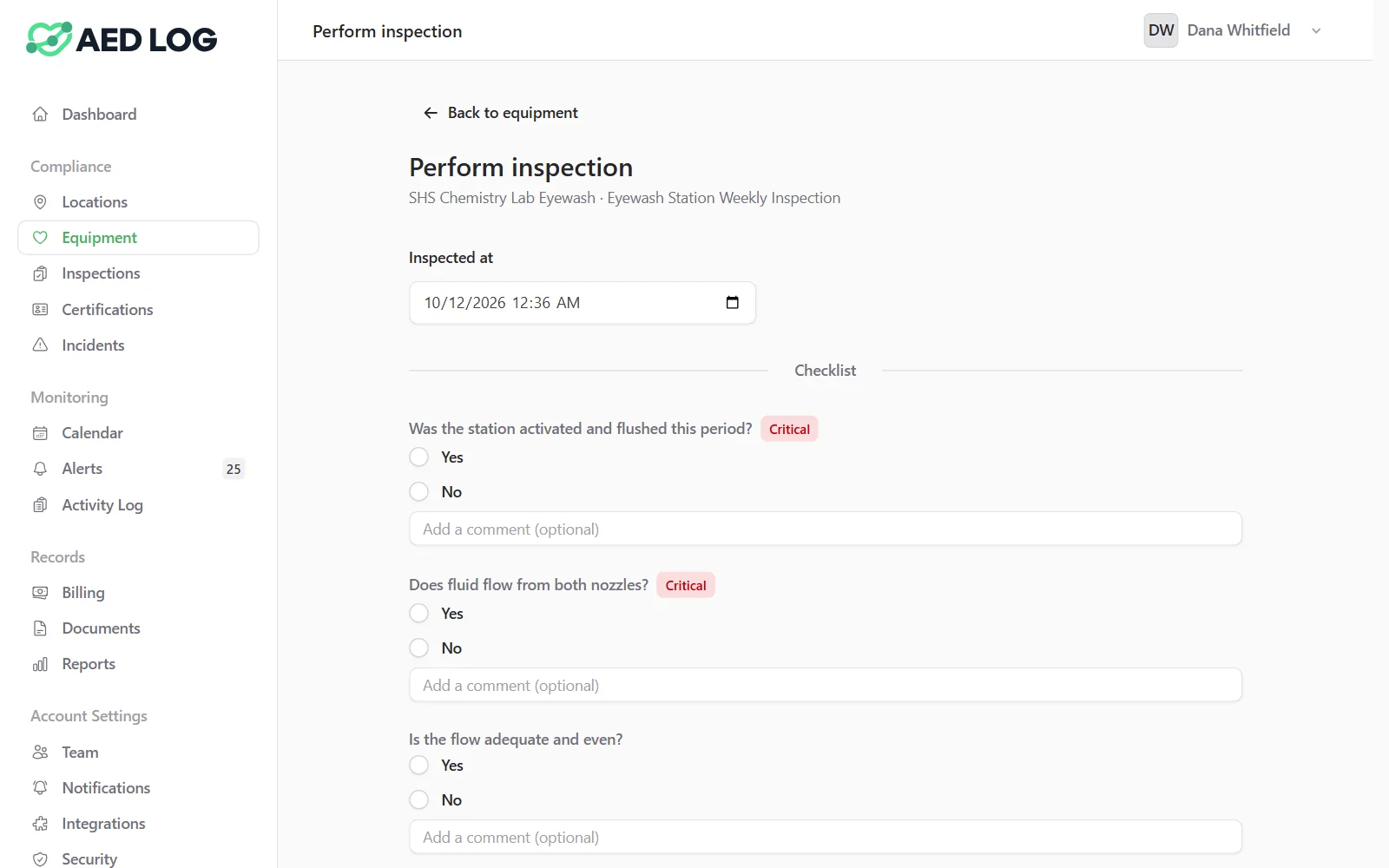
Eyewash stations
Where workers' eyes or bodies may be exposed to injurious corrosive materials, 29 CFR 1910.151(c) requires facilities for quick drenching or flushing within the work area. OSHA points employers to ANSI Z358.1, which calls for weekly activation of plumbed units, and AED Log's default eyewash checklist runs weekly. Eyewash station requirements
First aid kits
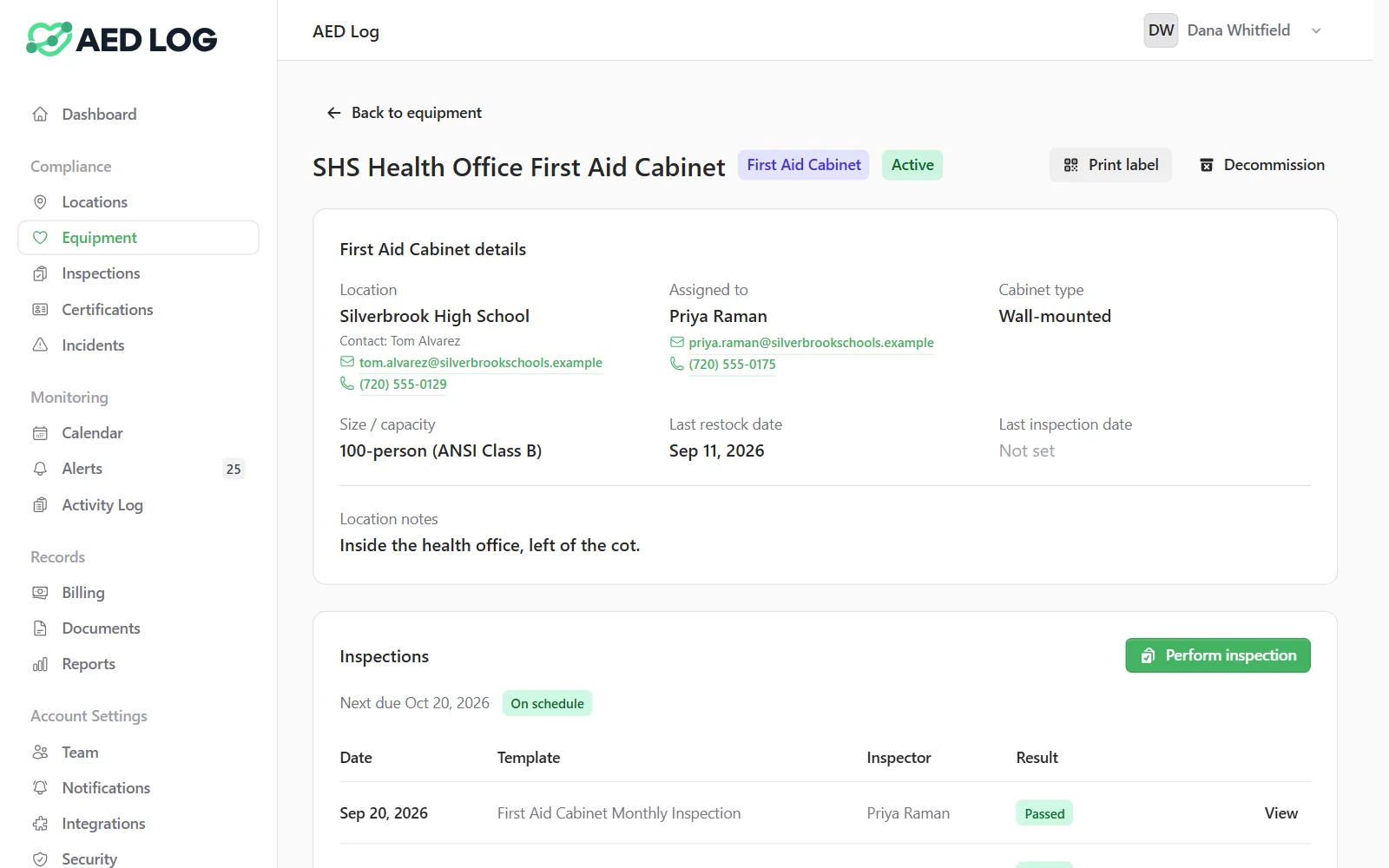
General industry must keep adequate first aid supplies readily available, and the construction rule, 29 CFR 1926.50(d)(2), requires kits to be checked before each job and at least weekly on each job. First aid kit requirements
Fire extinguishers
Portable extinguishers must be visually inspected monthly and get an annual maintenance check under 29 CFR 1910.157(e). AED Log tracks the monthly check and the service and hydrostatic test due dates. Fire extinguisher inspection requirements
How AED Log handles manufacturing and construction
AED Log gives each plant or job site its own equipment list, inspection schedule and site contact, all in one account.
Inspections in the field
Supervisors scan each unit's QR label and answer its checklist in the browser on any phone, with nothing to install.
Corrective actions that close themselves
A failed check opens a corrective action and alerts the responsible people. Record a passing inspection and the alert clears on its own.
Weekly checks where they're needed
Set the first aid check to weekly for construction kits and keep eyewash checks weekly; every equipment type keeps its own interval.
Dated records for audits
Inspection history, the expiration forecast and the audit trail download as a CSV or a branded PDF for any site or date range.
Several plants or job sites
Each plant or job site is a location, and locations are unlimited, so you pay one price for the number of AEDs in your tier.
Mark a job site inactive when the work ends and move its equipment to the next site; each unit's inspection history moves with it. Site supervisors see their own sites, and the safety director sees all of them on one dashboard.
Related guides and templates
These guides and free templates cover OSHA's rules and the checklists for each kind of safety equipment.
Eyewash station requirements First aid kit requirements Fire extinguisher inspection requirements Eyewash station inspection checklist (free PDF) Fire extinguisher inspection checklist
Manufacturing and construction AED FAQ
Inspect every safety station on one schedule
AEDs, eyewash stations, first aid kits and extinguishers at every plant and job site, with dated records.
45 days free. No credit card required. Then plans from $114 a year.