
AED model

LIFEPAK 500: Pads, Battery and Maintenance

Kyle Nowack, Co-founder of AED Log

By Kyle Nowack

Co-founder, AED Log

Last reviewed October 13, 2026 · 7 min read

Last reviewed against Stryker’s own manuals and product pages. Always follow the manual that came with your AED and the dates printed on your own pads and battery.

The short answer

The LIFEPAK 500 is a discontinued semi-automatic AED. Physio-Control ended its parts and repair support on January 31, 2018, Stryker stopped selling its batteries in 2020, and no pads have been marketed for it since February 3, 2022. Biphasic units with a pink connector took infant/child electrodes. Check your own manual for its ready indicator.

Key facts

  • Parts, inspection and repair support from Physio-Control ended January 31, 2018; units on an active service plan were covered until the plan ran out.
  • Stryker discontinued LIFEPAK 500 batteries on February 3, 2020. FDA records list a non-rechargeable lithium pack (11141-000157, 11141-000159) and a rechargeable lead-acid pack (11141-000002).
  • Stryker stopped marketing pads for the LIFEPAK 500 after February 3, 2022, and the LIFEPAK CR2's QUIK-STEP pads don't fit it.
  • Infant/Child Reduced Energy Defibrillation Electrodes (11101-000016) worked only on biphasic units with a pink connector.
  • Physio-Control (now Stryker) recommends replacing AEDs more than 8 years old, and Stryker has urged owners of older, non-PMA AEDs like this one to move to an FDA-approved model.

LIFEPAK 500 at a glance

The LIFEPAK 500 is a semi-automatic AED that Physio-Control introduced in 1997, in monophasic and biphasic versions. It's discontinued: Physio-Control, now part of Stryker, ended its parts, inspection and repair support on January 31, 2018.

LIFEPAK 500 at a glance, from Stryker’s documents.
DetailLIFEPAK 500
Made byPhysio-Control (now part of Stryker)
Introduced1997
VersionsSemi-automatic; monophasic and biphasic
Adult padsPart not published; not marketed for it since February 2022
ChildrenInfant/Child electrodes, biphasic units with a pink connector only
BatteryLithium or rechargeable lead-acid pack; discontinued February 2020
FDA premarket approvalNone (not among Stryker's PMA approvals)
StatusDiscontinued; support ended January 31, 2018

Physio-Control's November 2017 letter said it would stop providing parts, inspections and repairs for every LIFEPAK 500, monophasic and biphasic, from January 31, 2018. Units with an active service plan stayed covered until the plan expired. The same letter recommends replacing any AED that's more than 8 years old. In October 2020, Stryker pointed owners of older, non-PMA AEDs toward an FDA-approved model, offered trade-up options and named the LIFEPAK 1000 and LIFEPAK CR2 as its current public-access choices. The LIFEPAK 500 isn't among Stryker's FDA premarket approvals (PMA).

In short, Stryker no longer supports the LIFEPAK 500, and both letters point owners toward replacing it. FDA recall records list its model numbers as 3005400-XXX, U3005400-XXX, 3011790-XXX and U3011790-XXX, and a 2007 FDA record identifies 3011790 numbers as biphasic units.

LIFEPAK 500 biphasic and LIFEPAK 500 monophasic: how they differ

  • LIFEPAK 500 biphasic: The only version that can take Infant/Child Reduced Energy Defibrillation Electrodes, and only if it has a pink connector; FDA records tie part numbers beginning 3011790 to biphasic units.
  • LIFEPAK 500 monophasic: Can't use the reduced-energy child electrodes, and Stryker doesn't publish which part numbers are monophasic.

Other Stryker LIFEPAK (formerly Physio-Control) models we cover: LIFEPAK CR2, LIFEPAK 1000 and LIFEPAK CR Plus and EXPRESS.

LIFEPAK 500 pads

Stryker no longer markets any pads for the LIFEPAK 500: pads that also fit its current FDA-approved AEDs stayed on sale but stopped being marketed for the 500 after February 3, 2022. No Stryker or FDA document we found names the adult pad part number.

Stryker's October 2020 notice explains that pad electrodes shared with its FDA-approved (PMA) AEDs would stay on sale, but that after February 3, 2022 they would no longer be marketed for non-PMA devices such as the LIFEPAK 500. We found no LIFEPAK 500 operating instructions or accessory list on Stryker's site, and no Stryker or FDA document we read names the adult pad part, so we haven't listed a part number.

One pad is known not to work: Stryker warns that the LIFEPAK CR2's QUIK-STEP electrodes can't be used with the LIFEPAK 500. Whatever pads you have, go by the date printed on the package.

Using the LIFEPAK 500 on children

Only a biphasic LIFEPAK 500 with a pink connector could treat children, using Infant/Child Reduced Energy Defibrillation Electrodes (11101-000016) for a child younger than 8 or lighter than 55 pounds. Monophasic units can't use them.

Physio-Control's Infant/Child Reduced Energy Defibrillation Electrodes, sold as a starter kit (11101-000017) and a replacement set (11101-000016), fit only a biphasic LIFEPAK 500 with a pink connector. They're for a child younger than 8 or lighter than 55 lb (25 kg). A monophasic LIFEPAK 500 can't use them.

The FDA's 2020 recall record for these electrodes still lists the LIFEPAK 500 among the AEDs they're used with. Stryker's store now names only the LIFEPAK 1000 and CR Plus, though, and the electrodes haven't been marketed for the 500 since February 3, 2022.

For the general rules on child pads, ages and placement, see our guide to pediatric AED pads.

LIFEPAK 500 battery

Stryker discontinued LIFEPAK 500 batteries on February 3, 2020, so the maker no longer sells them. FDA records list 2 types: a non-rechargeable lithium sulfur dioxide pack (11141-000157, 11141-000159) and a rechargeable sealed lead-acid pack (11141-000002).

Stryker's October 2020 notice lists LIFEPAK 500 batteries among the accessories it discontinued on February 3, 2020. The FDA's device database (GUDID) shows 2 battery types for the AED: a non-rechargeable lithium sulfur dioxide pack, catalog numbers 11141-000157 and 11141-000159, and a rechargeable sealed lead-acid pack, 11141-000002. GUDID still marks the lithium packs as in commercial distribution, which conflicts with Stryker's letter; we go by Stryker.

None of the Stryker or FDA documents we found give the battery's shelf life, standby life, shock count or low-battery warning, so check the label on your own battery and the manual that came with the AED.

How other models compare is in our AED battery replacement guide.

LIFEPAK 500 part numbers and shelf life

These are the LIFEPAK 500 parts we could trace to a Stryker or FDA document. Stryker has stopped selling or marketing all of them for this AED, and it doesn't publish their shelf lives.

Replacement parts for the LIFEPAK 500, with Stryker’s part numbers and shelf lives (checked October 13, 2026). Go by the date printed on your own parts.
PartPart numberShelf lifeReplace
Adult pad electrodes
Adults
Not publishedNot stated by StrykerPart not published; Stryker stopped marketing pads for the LIFEPAK 500 after February 3, 2022
Infant/Child Reduced Energy Defibrillation Electrodes
Children under 8 or under 55 lb, biphasic units with a pink connector only (starter kit 11101-000017)
11101-000016Not stated by StrykerBy the date on the package; no longer marketed for the LIFEPAK 500 after February 3, 2022
LIFEPAK 500 lithium sulfur dioxide battery
Battery (non-rechargeable)
11141-000157 / 11141-000159Not stated by StrykerDiscontinued by Stryker on February 3, 2020
LIFEPAK 500 sealed lead-acid battery
Battery (rechargeable)
11141-000002Not stated by StrykerDiscontinued by Stryker on February 3, 2020

Because Stryker doesn't publish a shelf life for any of these parts, AED Log's catalog entries for the LIFEPAK 500 carry no default expiration. When you record pads or a battery, type the date printed on the package or label. The catalog's "Replacement Battery" entry stands for either battery type above.

LIFEPAK 500 self-test and status indicator

We couldn't find the LIFEPAK 500 operating instructions on Stryker's website, so its self-test schedule and readiness indicator aren't covered here. Use the manual that came with your unit.

The LIFEPAK 500's self-test schedule, readiness indicator and storage temperature range would all be in its operating instructions, and we couldn't find those on Stryker's website. Check the manual that came with your AED for how it shows it's ready.

One check is documented. In its 2020 safety notice, Stryker told owners to keep doing the External Test Load Test described in the maintenance section of the operating instructions, and to take the AED out of service at once if it gives the CONNECT ELECTRODES prompt during that test.

If the indicator ever shows a problem, our guide to AED self-test failures and status lights covers what to do first.

LIFEPAK 500 maintenance checklist

Stryker's 2020 safety notice for the LIFEPAK 500 told owners to keep running the External Test Load Test from the operating instructions, and to take the AED out of service if it says CONNECT ELECTRODES during that test.

  • Run the External Test Load Test as the operating instructions describe, and take the AED out of service if it says CONNECT ELECTRODES.
  • Check the readiness indicator the way your operating instructions describe.
  • The pads are sealed and within the date printed on the package.
  • The battery is within the date on its label; Stryker no longer sells replacements.
  • Any Infant/Child electrodes are sealed, in date and kept only with a biphasic unit that has a pink connector.
  • A replacement AED is in your plan: support ended in 2018, and Physio-Control (now Stryker) recommends replacing AEDs more than 8 years old.

Print our free AED inspection checklist to record each check, or read the full AED maintenance guide.

LIFEPAK 500 recalls

The FDA's recall database lists LIFEPAK 500 recalls from 2005 (Class I), 2013 and 2020, plus recalls of the infant/child electrodes used with it. All of them are now closed.

FDA recalls that cover the LIFEPAK 500 or its accessories, newest first. From the FDA’s Medical Device Recall database, checked October 12, 2026.
DateProductClassWhat it’s about and what to doStatusFDA record
Apr 24, 2020Infant/child electrodes 3202380-006IIPackaging not properly sealed.Closed 2023Z-2359-2020
Mar 20, 2020LIFEPAK 500IIConnector wear can stop the AED detecting a patient.Closed 2024Z-1633-2020
Oct 27, 2017Infant/child electrodes 11101-000016IArtwork showed the wrong infant pad placement.Closed 2019Z-0186-2018
Jun 12, 2013LIFEPAK 500 (139 units)IIAn assembly error could short a circuit board and leave the AED unusable. Physio-Control replaced affected units.Closed 2013Z-1773-2013
Feb 3, 2005LIFEPAK 500IMight not detect a patient at the low end of the impedance range. Units were corrected or replaced.Closed 2006Z-0562-05

Every AED recall, by manufacturer, is on our AED recall list.

How AED Log tracks the LIFEPAK 500

In AED Log you pick the LIFEPAK 500 from the built-in catalog, record its pads and battery with their lot numbers and dates, and get a warning before either expires, plus a monthly inspection reminder.

Each pad set and battery is its own record with its own expiration date, so a pad set or battery never lapses unnoticed. Choose the part from the catalog and its shelf life fills in the expiration date for you; you can always type the date printed on the package instead. Alerts go out by email, Slack, Teams or Discord to the people responsible for that site, and the monthly inspection checklist asks about the status indicator, the pads and the battery. See pad and battery expiration tracking and AED management for more, or see every AED model.
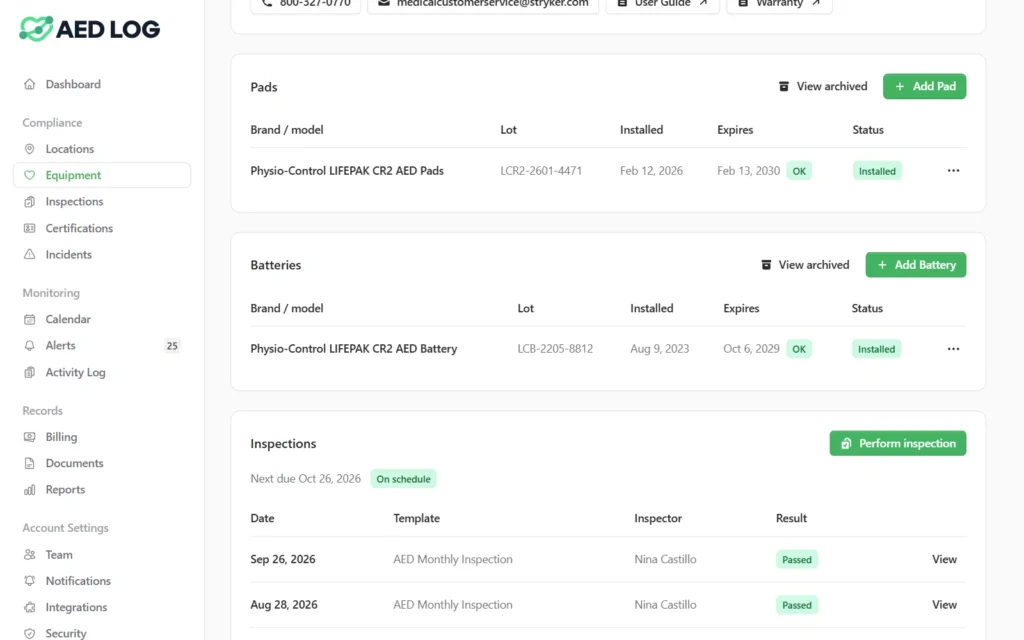
The pads and batteries on an AED in AED Log, each with its lot number, installed date, expiration date and status, above the unit's inspection schedule
An AED’s pads and batteries in AED Log, each with its lot number, installed date and expiration date.

LIFEPAK 500 FAQ

How long do LIFEPAK 500 pads last?

Stryker doesn't publish a shelf life for LIFEPAK 500 pads, and it stopped marketing pads for this AED after February 3, 2022. Go by the date printed on your pad package.

How long does the LIFEPAK 500 battery last?

Stryker doesn't publish the LIFEPAK 500 battery's life, and it discontinued the batteries on February 3, 2020. Check the date on your battery's label and the manual that came with the AED.

Can you use the LIFEPAK 500 on a child?

Only a biphasic LIFEPAK 500 with a pink connector can, using Infant/Child Reduced Energy Defibrillation Electrodes for a child under 8 or under 55 lb (25 kg). Monophasic units can't use them, and they haven't been marketed for the 500 since 2022.

Is the LIFEPAK 500 still supported?

No. Physio-Control ended parts, inspection and repair support on January 31, 2018, and Stryker discontinued its batteries in 2020. Physio-Control (now Stryker) recommends replacing AEDs more than 8 years old, and Stryker urges moving older AEDs to an FDA-approved model.

Keep every AED ready

AED Log tracks inspections, pads, batteries, certifications and incidents for every AED, whatever the brand.

45 days free. No credit card required. Then plans from $114 a year.