
Schools
AED Program Management for Schools and School Districts
AEDs in schools have to be ready for every school day, gym class and game, at every campus. AED Log tracks each school's AEDs, Stop the Bleed kits and staff CPR certifications, with reports by campus for the district.
45 days free. No credit card required. Then plans from $114 a year.
Do schools need an AED?
In many states, yes. State law decides whether a school must have an AED and what goes with it, and the AED law data in AED Log lists 40 jurisdictions that require a school cardiac emergency response plan.
What state laws require
Requirements differ from state to state: whether every school needs an AED, who must be trained to use it, how it must be maintained and whether a written response plan is required. Our AEDs in schools by state page shows what states require AEDs in schools and what each one asks for, and AED laws by state covers the rest of each state's AED law.
Why minutes matter at school
The chance of surviving sudden cardiac arrest falls by 7 to 10 percent for every minute without CPR or defibrillation, according to OSHA. A school is full of people who can start CPR and fetch an AED, so a well-placed, well-kept AED gives a student, a teacher or a visiting parent a real chance.
What a compliant school AED program includes
A school AED program puts an AED within quick reach of every building and field, keeps each one inspected, and trains the people who will use it.

AEDs in each building and at athletic venues, clearly marked and accessible
A written cardiac emergency response plan and a trained response team
A monthly inspection of every AED, recorded and dated
Pads and batteries, pediatric pads included, replaced before they expire
Staff CPR and AED certifications kept current
Drills and a yearly review of the plan, and a debrief after any use
Elementary and middle schools also need pediatric pads or a child key, which have their own expiration dates. Keep them with the AED and check them in the same monthly inspection as the adult pads.
Cardiac emergency response plans and Desha's Law
A cardiac emergency response plan (CERP) sets out who responds to a sudden cardiac arrest at school, how they're alerted, where the AEDs are, and how the plan is practiced and reviewed.
What the American Heart Association recommends
The American Heart Association's CERP guidance for schools lists the core steps: build the plan and a response team, share it and connect it to local EMS, place and maintain AEDs, keep staff trained in CPR and AED use, teach CPR widely, practice with drills, activate the team in an emergency, and review the plan every year.
Desha's Law in New York
New York's Desha's Law, Chapter 189 of the Laws of 2025, requires each school district's safety plan to include a cardiac emergency response plan, and requires the AEDs in its instructional facilities to be clearly marked, accessible and maintained. Most of it took effect on January 20, 2026, according to the New York State Education Department. Read our Desha's Law guide for the details.
Stop the Bleed kits for schools
Many schools keep Stop the Bleed kits beside their AEDs, and the kits need checking too: tourniquets, hemostatic gauze and dressings can expire, be used or go missing.
AED Log tracks each kit as its own unit, with its tourniquets, gauze and dressings and their expiration dates, and a default quarterly check of the seal and contents. Stop the Bleed kit tracking is an add-on at $8 per kit per year, on top of your AED plan.
AED grants for schools
Grants and donations can pay for school AEDs. They come from state education agencies, hospital and community foundations and AED nonprofits, and most run on a yearly cycle.
Recent examples include the Kentucky Department of Education's AED grant for school districts and Minnesota's cardiac emergency response plan grants, and the Hopey's Heart Foundation donates AEDs to public schools and other eligible groups. AED Log doesn't offer grants itself, but the inspection records it keeps are what many grants ask you to maintain.
How AED Log handles school AED programs
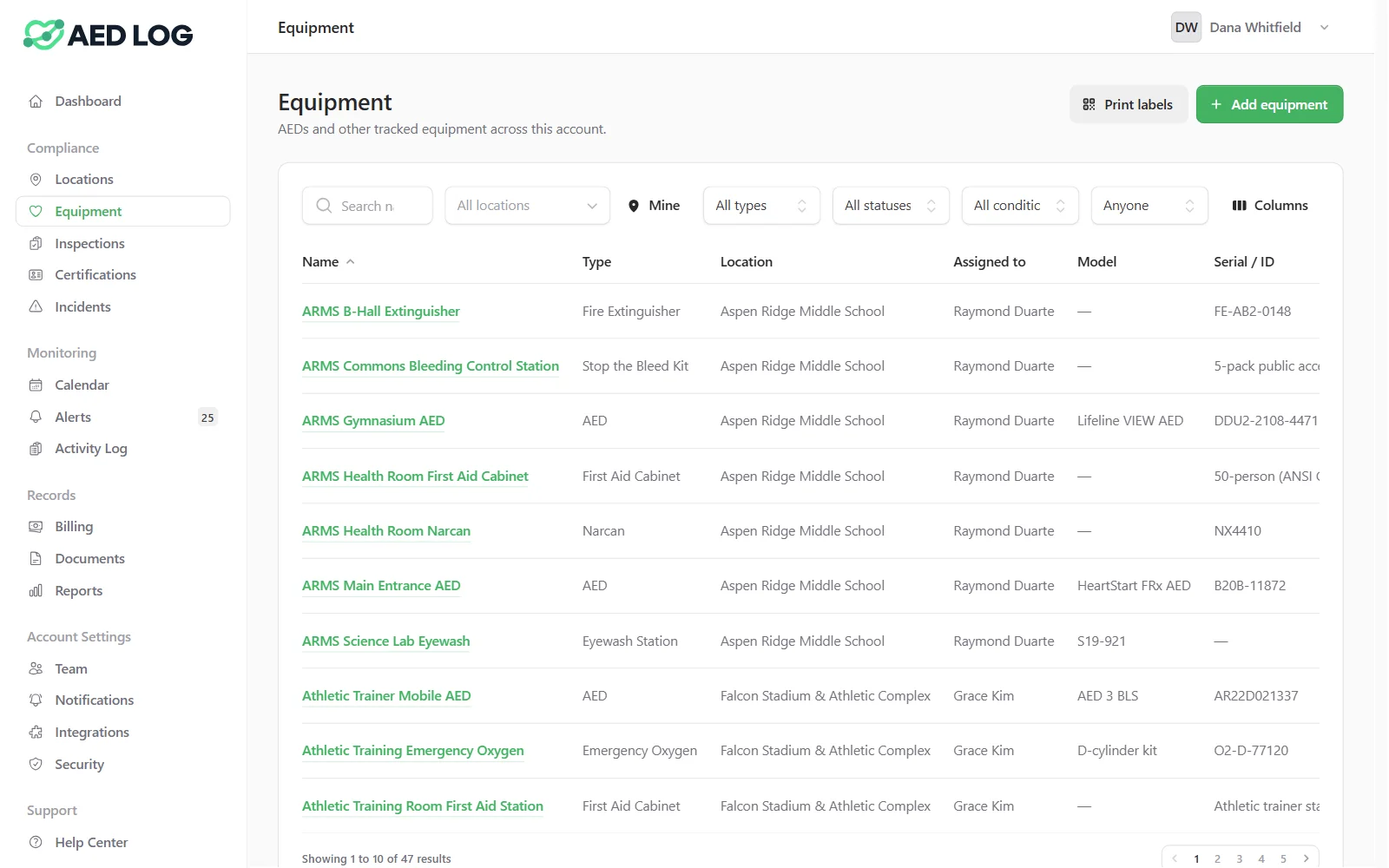
AED Log gives each campus its own place for its AEDs, kits and responders, and gives the district one view of all of them.
Inspections by the people on site
A nurse, athletic trainer or custodian scans the AED's QR label and answers the monthly checklist on a phone. A failed check opens a corrective action and alerts the people responsible until it's fixed.
Staff certifications
Record each staff member's CPR and AED card from a catalog of 185 certifications, including American Heart Association and American Red Cross courses, and get a warning before any card expires.
Audit-ready reports by campus
Download inspection history, the expiration forecast and certification status for one school or the whole district, as a CSV or a branded PDF.
Every safety item on one system
Add Stop the Bleed kits, first aid cabinets, eyewash stations in science labs and fire extinguishers, each with its own checklist. See every equipment type.

Managing AEDs across a whole district
Each school is a location, and locations are unlimited, so a district pays one flat price for the number of AEDs in its tier.
Limit principals and nurses to their own campus while district safety staff see every school on one dashboard, with expired pads and overdue checks listed first. A district with 50 AEDs pays $3,000 a year, however many schools they are spread across.
Related guides and templates
These guides and free templates cover the rest of a school AED program, from state law to the monthly checklist.
AEDs in schools by state Cardiac emergency response plan template AED inspection checklist (free PDF) How to start an AED program CPR and AED certification
School AED program FAQ
Keep every school's AEDs ready
Inspections, pads, batteries and staff certifications for every campus, with reports for the whole district.
45 days free. No credit card required. Then plans from $114 a year.