

Philips HeartStart FR3 part numbers and shelf life
These are the parts an FR3 owner replaces, with Philips's part numbers and shelf lives. Heartstream's US site doesn't list FR3 accessories, so confirm with Heartstream that you can still get them before you need them.
| Part | Part number | Shelf life | Replace |
|---|---|---|---|
| HeartStart SMART Pads III Adults, and children with the key (989803149991 is a pack of 5 sets) | 989803149981 | Expiration date at least 30 months from manufacture | By the expiration date, or after any use |
| HeartStart DP adult pads Adults; can't be pre-connected (989803158221 is a pack of 5 sets) | 989803158211 | Not stated by Philips | By the date on the package, or after any use |
| FR3 Infant/Child Key Children under 55 lb (25 kg) or up to 8 years | 989803150031 | Not stated by Philips (no expiration date) | If lost or damaged |
| FR3 primary clinical use battery Standard battery | 989803150161 | Install by the label date; at least 3 years in standby once installed | When the FR3 asks (REPLACE BATTERY), or by the install-by date for a spare |
| FR3 primary clinical use battery, FAA compliant Aircraft use | 989803150171 | Install by the label date; at least 3 years in standby once installed | When the FR3 asks (REPLACE BATTERY), or by the install-by date for a spare |
| FR3 rechargeable clinical use battery Frequent-use settings only; charged in charger 861394 | 989803150241 | Not stated by Philips; about 4 months of standby per charge | Not stated by Philips; not recommended for public access AEDs or as a spare |
Philips HeartStart FR3 self-test and status indicator
The FR3 tests itself at least once every 24 hours in standby, with more detailed weekly and monthly tests. A flashing green Ready light means it's ready; if the light goes out and the FR3 chirps, it has found a problem.
In standby the FR3 tests itself at least once every 24 hours, and also two hours after it's turned off or a battery is installed. The daily, weekly and monthly tests grow more detailed in turn, and the FR3 also tests itself each time it's switched on. The tests cover pre-connected SMART Pads III in the Pads Sentry and any installed data card. You can run a detailed user-initiated test from the Administration menu; Philips recommends one after each use and if the AED is dropped.
When the Ready light goes dark and the FR3 gives single chirps, press On/Off, then press it again to see the status screen, which names the problem, such as REPLACE BATTERY or REPLACE PADS. The FR3 may still work in an emergency. Triple chirps are more serious: turn the FR3 on to read the error, write it down, remove the FR3 from service and call Heartstream.
If the indicator ever shows a problem, our guide to AED self-test failures and status lights covers what to do first.
Philips HeartStart FR3 maintenance checklist
Philips leaves the FR3's maintenance schedule to the program's medical director and offers a sample daily and monthly routine: check the Ready light, the supplies and spares, and the case and connector.
- The Ready light flashes green, and the FR3 isn't chirping.
- Pre-connected SMART Pads III are seated in the Pads Sentry, sealed and within their expiration date.
- The Infant/Child Key isn't left installed in the FR3.
- The battery and any spare are within their install-by dates, and the status screen shows no battery warning.
- Supplies, accessories and spares show no damage and are within their dates.
- The case and connector are free of cracks, and the FR3 is stored between 32 and 122°F (0 and 50°C).
- Checks happen as often as your program's medical director requires.
After the Philips HeartStart FR3 is used
- If you use a data card, download it and fit a replacement.
- Install a new set of pads, pre-connected in the Pads Sentry.
- Check and clean the outside of the FR3 and its connector.
- Run a user-initiated test from the Administration menu.
Print our free AED inspection checklist to record each check, or read the full AED maintenance guide.
Philips HeartStart FR3 recalls
The FDA's recall database lists Class II recalls of the FR3 in 2014 and 2018, both now closed: one for a circuit board that could come loose, and one for water resistance.
| Date | Product | Class | What it’s about and what to do | Status | FDA record |
|---|---|---|---|---|---|
| Oct 10, 2018 | HeartStart FR3 | II | May not fully meet its water-resistance specification. | Closed 2022 | Z-0175-2019 |
| Feb 6, 2014 | HeartStart FR3 861388 and 861389 (specific serial numbers) | II | The circuit board that supplies shock energy could come loose from its contacts, leaving the AED unable to shock. Philips replaced affected units free of charge. | Closed 2017 | Z-1225-2014 |
Every AED recall, by manufacturer, is on our AED recall list.
How AED Log tracks the Philips HeartStart FR3
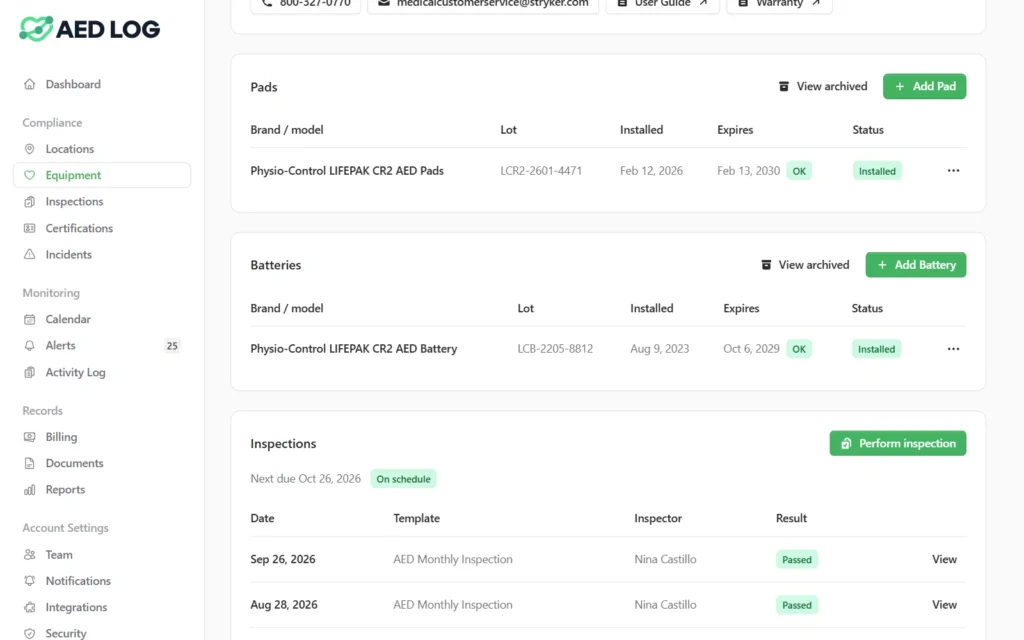
In AED Log you pick the Philips HeartStart FR3 from the built-in catalog, record its pads and battery with their lot numbers and dates, and get a warning before either expires, plus a monthly inspection reminder.
Each pad set and battery is its own record with its own expiration date, so a pad set or battery never lapses unnoticed. Choose the part from the catalog and its shelf life fills in the expiration date for you; you can always type the date printed on the package instead. Alerts go out by email, Slack, Teams or Discord to the people responsible for that site, and the monthly inspection checklist asks about the status indicator, the pads and the battery. See pad and battery expiration tracking and AED management for more, or see every AED model.
Philips HeartStart FR3 FAQ
How long do Philips HeartStart FR3 pads last?
Philips labels SMART Pads III with an expiration date at least 30 months after manufacture. Replace them by that date and after any use. The same pads serve adults and, with the Infant/Child Key, children.
How long does the Philips HeartStart FR3 battery last?
The FR3 primary battery (989803150161) lasts at least 3 years in standby once installed; fit it by the date on its label. Philips gives no shelf life in months before installation. The rechargeable version lasts only 4 months in standby.
Can you use the Philips HeartStart FR3 on a child?
Yes. For a child aged 8 or younger, or under 55 pounds (25 kg), fit the FR3 Infant/Child Key (989803150031) and use the regular SMART Pads III. The shock drops to 50 joules. Keep the key out of the AED otherwise, or the self-test fails.
Is the Philips HeartStart FR3 discontinued?
Heartstream, which took over Philips's AED business, doesn't list the FR3 on its US site, but no end-of-sale notice has been published and the FDA still lists it as approved. Confirm pad and battery availability with Heartstream.