

Philips HeartStart OnSite part numbers and shelf life
These are the parts an OnSite owner replaces, with Philips's part numbers and shelf lives. The M5070A battery is the same one the FRx and HeartStart Home use.
| Part | Part number | Shelf life | Replace |
|---|---|---|---|
| Adult SMART Pads Cartridge Adults and anyone 55 lb (25 kg) or heavier | M5071A | Use-by date at least 2 years from manufacture | By the use-by date, or after any use |
| Infant/Child SMART Pads Cartridge Children under 55 lb (25 kg) or up to 8 years; prescription only | M5072A | Use-by date at least 2 years from manufacture | By the use-by date, or after any use |
| M5070A battery Battery (also fits the FRx and HeartStart Home) | M5070A | At least 5 years from manufacture before installing; typically 4 years installed | When the OnSite warns of a low battery (typically about 4 years after installing) |
Need replacements? Total AEDs, AED Log’s sister store, sells pads, batteries and the AED itself for the Philips HeartStart OnSite. Any authorized distributor works; the FDA advises buying AED accessories only from authorized sources.
Philips HeartStart OnSite self-test and status indicator
The OnSite tests itself every day in standby, pads included, and runs further checks weekly and monthly. A blinking green Ready light means it's ready; chirps or a dark Ready light mean it needs attention.
In standby the OnSite runs daily, weekly and monthly self-tests covering battery capacity, the pads cartridge and its internal circuits. Removing the battery for five seconds and putting it back starts a more thorough battery insertion test that takes about a minute. That test uses up battery power, so Philips suggests running it only when the AED is first set up, after each use, after a battery change, or if it may be damaged. While the Ready light keeps blinking, there's no need to run it.
A dark Ready light with single chirps and a flashing i-button points to a fixable problem such as a low battery or a pads issue. Triple chirps signal something more serious: take the OnSite out of service and contact Heartstream. Philips warns that pulling and reinserting the battery can make the AED look ready when it may not be able to shock. A dark light with no chirps means no battery, a flat battery or a unit that needs repair.
If the indicator ever shows a problem, our guide to AED self-test failures and status lights covers what to do first.
Philips HeartStart OnSite maintenance checklist
Philips doesn't set a fixed interval for OnSite checks. It asks owners to look at the Ready light, swap out used, damaged or expired supplies and inspect the case from time to time, and to log every check.
- The Ready light blinks green, and the OnSite isn't chirping.
- The adult SMART Pads Cartridge is installed, sealed and within its use-by date.
- A spare cartridge and a spare battery are stored with the AED, both within their dates.
- Any infant/child cartridge on hand is sealed and within its use-by date.
- The maintenance tag shows the current pads expiration date and the spare battery's install-by date.
- The case has no cracks, and the OnSite is kept between 50 and 109°F (10 and 43°C).
- The check is signed and dated in your inspection log.
After the Philips HeartStart OnSite is used
- Check the outside of the OnSite for damage or dirt, and replace the used pads cartridge.
- Look over supplies and accessories for damage and past-due dates, and replace anything used, damaged or expired.
- Unless your protocol says to leave the battery in, take it out for five seconds and put it back to run the battery insertion test, then confirm the Ready light is blinking.
- Update the maintenance tag, sign and date the inspection log, and store the OnSite with an adult cartridge installed.
Print our free AED inspection checklist to record each check, or read the full AED maintenance guide.
Philips HeartStart OnSite recalls
The FDA's recall database lists several Class II recalls of the OnSite and its pad cartridges since 2012. Two are still open: a 2022 notice that pad gel can peel away from its backing, and a 2021 follow-up for owners missed by earlier recalls.
| Date | Product | Class | What it’s about and what to do | Status | FDA record |
|---|---|---|---|---|---|
| Feb 4, 2022 | HeartStart SMART Pads cartridges M5071A and M5072A | II | Pad gel can separate from the backing. Keep the AED in service with a spare cartridge; unexpired lots starting with Y qualify for a free replacement if you respond. | Open | Z-0881-2022 |
| Jul 16, 2021 | HeartStart Infant/Child SMART Pads M5072A (one lot) | II | Labeling error. | Closed 2023 | Z-2427-2021 |
| Feb 9, 2021 | HeartStart FR2, FRx, HS1 (34 units) | II | Owners missed by earlier recalls. Philips exchanges affected AEDs; return the reply form. | Open | Z-0078-2022 |
| Sep 10, 2019 | HeartStart FRx and HS1 (140 units) | II | Circuit assemblies repaired outside required procedures; units replaced. | Closed 2024 | Z-1271-2020 |
| Aug 8, 2018 | HeartStart Infant/Child SMART Pads M5072A | II | Wrong age range printed on the pouch. | Closed 2021 | Z-2549-2019 |
| Mar 14, 2018 | HeartStart FRx and HS1 | II | A resistor issue could prevent a shock. | Closed 2020 | Z-1913-2018 |
| Feb 6, 2014 | HeartStart OnSite and Home (HS1), specific serial numbers | II | Residue from soldering on the contact pins could keep the pads cartridge from connecting, so the AED might not shock. Philips replaced affected units free of charge. | Closed 2017 | Z-1232-2014 |
| Jul 26, 2012 | HeartStart FRx and HS1 (OnSite, Home) shipped December 2005 to July 2012 | II | Philips clarified the maintenance information in its owner’s manuals and asked owners to contact it to confirm their AED was working. | Closed 2020 | Z-0642-2013 |
Every AED recall, by manufacturer, is on our AED recall list.
How AED Log tracks the Philips HeartStart OnSite
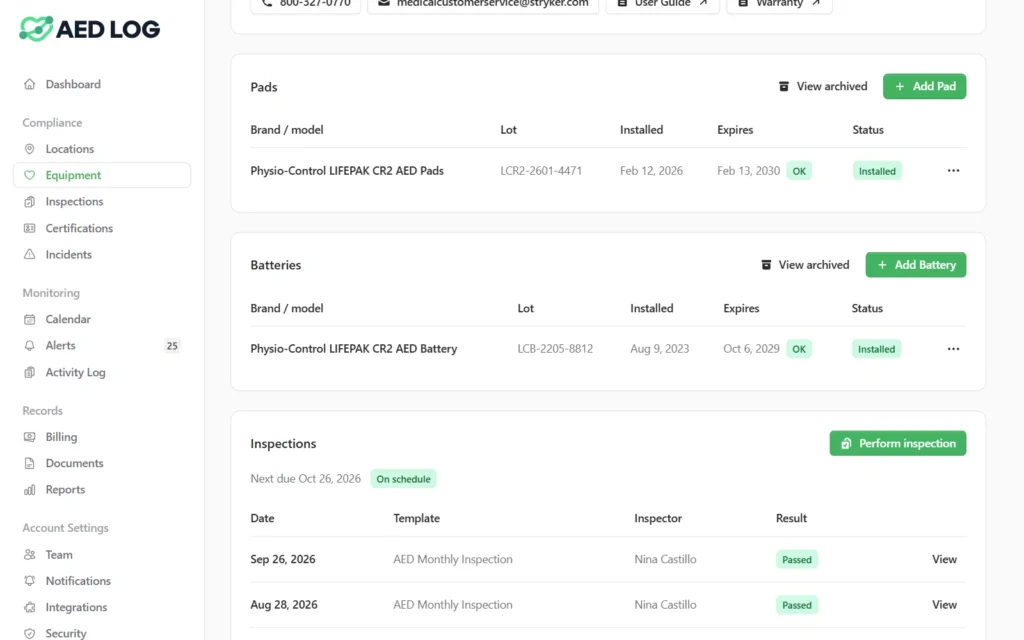
In AED Log you pick the Philips HeartStart OnSite from the built-in catalog, record its pads and battery with their lot numbers and dates, and get a warning before either expires, plus a monthly inspection reminder.
Each pad set and battery is its own record with its own expiration date, so a pad set or battery never lapses unnoticed. Choose the part from the catalog and its shelf life fills in the expiration date for you; you can always type the date printed on the package instead. Alerts go out by email, Slack, Teams or Discord to the people responsible for that site, and the monthly inspection checklist asks about the status indicator, the pads and the battery. See pad and battery expiration tracking and AED management for more, or see every AED model.
Philips HeartStart OnSite FAQ
How long do Philips HeartStart OnSite pads last?
Philips labels each OnSite pads cartridge, adult (M5071A) or infant/child (M5072A), with a use-by date at least 2 years after manufacture. Replace the cartridge by that date, and after any use.
How long does the Philips HeartStart OnSite battery last?
The M5070A battery keeps at least 5 years from manufacture before you install it, so fit it by the date on its label. Once in the OnSite it typically lasts about 4 years. A low battery turns off the Ready light and makes the AED chirp.
Can you use the Philips HeartStart OnSite on a child?
Yes. For a child aged 8 or younger, or under 55 pounds (25 kg), use the M5072A Infant/Child SMART Pads Cartridge, which needs a prescription. The OnSite then lowers its shock to 50 joules. Without one, use the adult cartridge and don't delay.
Do you need a prescription for the Philips HeartStart OnSite?
Not with the adult pads cartridge: in the US the OnSite is sold over the counter. The M5072A Infant/Child SMART Pads Cartridge is the exception, and it's prescription only.
What battery does the Philips HeartStart OnSite take?
The M5070A, a non-rechargeable 9-volt lithium manganese dioxide battery that also fits the FRx and HeartStart Home. Install it by the date on its label; it typically lasts about 4 years in the AED.