
AED model

Philips HeartStart FR2 and FR2+: Pads, Battery and Maintenance

Kyle Nowack, Co-founder of AED Log

By Kyle Nowack

Co-founder, AED Log

Last reviewed October 13, 2026 · 8 min read

Last reviewed against Philips’s own manuals and product pages. Always follow the manual that came with your AED and the dates printed on your own pads and battery.

The short answer

The HeartStart FR2 and FR2+ use HeartStart adult pads (989803158211) and, for children, M3870A reduced-energy pads; Philips's manual gives neither a shelf life. The M3863A lithium battery typically lasts 5 years installed. A flashing black hourglass means it's ready. Both are discontinued, and Philips's last US pad and battery orders closed December 31, 2020.

Key facts

  • Adult pads: HeartStart adult pads, 989803158211 (989803158221 for five); Philips's FR2+ manual gives no shelf life.
  • Child pads: M3870A infant/child reduced-energy pads, which cut the shock to 50 joules, for children under 8 or under 55 lb.
  • Battery: M3863A lithium, typically 5 years from manufacture unopened and typically 5 years (more than 4) once installed.
  • A flashing black hourglass means ready; a flashing or solid red X with chirps means it needs attention.
  • Philips took its last US orders for pads and batteries on December 31, 2020, with no US shipments after February 2, 2021.

HeartStart FR2 at a glance

The HeartStart FR2 and FR2+ are discontinued semi-automatic AEDs for trained responders. Philips stopped taking FR2+ orders in 2009, announced the end of support on December 31, 2018, and stopped shipping FR2 pads and batteries to the US after February 2, 2021.

Philips HeartStart FR2 and FR2+ at a glance, from Philips’s documents.
DetailHeartStart FR2
Made byPhilips (first sold as the Heartstream FR2); Philips's AED business has been Heartstream since January 8, 2026
VersionsFR2 and FR2+: M3860A (ECG) and M3861A (text); Laerdal M3840A and M3841A
ShockSemi-automatic: 150 J for adults, 50 J with child pads
Adult padsHeartStart adult pads 989803158211; shelf life not stated
ChildrenM3870A infant/child reduced-energy pads
BatteryM3863A lithium, typically 5 years installed
Self-testDaily and weekly, plus a fuller monthly test
Ready indicatorFlashing black hourglass
Standby range32 to 109°F (0 to 43°C)
StatusDiscontinued; last US pad and battery orders December 31, 2020

The FR2 came first, cleared by the FDA in 2000 as the Heartstream FR2. Philips later sold the HeartStart FR2+, cleared in 2005, which it calls an enhanced FR2 with all of the original's features. Every FR2 accessory works in the FR2+, but some accessories labeled FR2+ work only in the FR2+. Both use model numbers M3860A and M3861A, so check the label for FR2+.

The FR2+ is a prescription device for responders trained in its use. It's semi-automatic, giving 150 joules to adults, and weighs 4.7 pounds (2.1 kg) with the standard battery. After a shock it pauses for CPR with an on-screen countdown bar but doesn't coach CPR. Philips sold its emergency care business to Bridgefield Capital on January 8, 2026, and it now runs as Heartstream, whose US site lists only the OnSite, HeartStart Home and FRx. Neither the FR2 nor the FR2+ is on the FDA's list of approved AEDs, and the FDA warns that accessories for unapproved AEDs may no longer be available after February 3, 2022.

HeartStart FR2 and HeartStart FR2+: how they differ

  • HeartStart FR2: The original version, cleared by the FDA in 2000 as the Heartstream FR2. It takes every FR2 accessory but not the FR2+-only ones, such as the M3848A rechargeable battery.
  • HeartStart FR2+: Philips's enhanced FR2, cleared in 2005, with all the FR2's features. The M3860A shows the ECG and allows a manual charge in advanced mode, the M3861A shows text only, and the M3840A and M3841A are Laerdal-branded twins.

Other Philips (now Heartstream) models we cover: Philips HeartStart OnSite, Philips HeartStart FRx and Philips HeartStart FR3.

HeartStart FR2 pads

The FR2 and FR2+ use HeartStart adult defibrillator pads, 989803158211 for one pouch or 989803158221 for five. Philips's FR2+ manual doesn't give a shelf life, so go by the date on the package, and replace pads after any use.

Philips's FR2+ manual approves only these pads: the HeartStart adult pads (989803158211 or 989803158221), the M3870A child pads, and parts M3713A and M3716A. Store the pads sealed and unplugged: Philips says not to keep them connected to the AED or to open the package until you need them. Their storage and transport range is 32 to 110°F (0 to 43°C).

Philips's 2019 letter to US customers set December 31, 2020 as the last day to order the adult pads for US delivery. Philips's current FRx manual says SMART Pads II (989803139261) can be used on adults with the FR2 and FR2+, but not on children. The FR2+ manual's own approved list doesn't include them, so check with Heartstream before relying on them.

Using the HeartStart FR2 on children

Yes, with M3870A infant/child reduced-energy pads, for a child who looks younger than 8 or weighs under 55 pounds (25 kg). Electronics in the pad connector cut the shock to 50 joules. Without them, Philips says to use adult pads and not delay.

For a child who looks younger than 8 or weighs under 55 pounds (25 kg), Philips says to use the M3870A FR2 infant/child reduced-energy pads if they're available. The energy reduction happens in the pads: electronics in the M3870A connector cut the shock to 50 joules. The FDA cleared the M3870A as Heartstream attenuated defibrillation pads in 2001. If no child pads are on hand, use the adult pads and don't delay treatment.

December 31, 2020 was the last day to order M3870A pads for US delivery, and Philips's FR2+ manual doesn't give them a shelf life. SMART Pads II aren't an option for children on the FR2 or FR2+: Philips's FRx manual says to use the M3870A instead.

For the general rules on child pads, ages and placement, see our guide to pediatric AED pads.

HeartStart FR2 battery

The standard battery is the M3863A, a non-rechargeable 12-volt lithium manganese dioxide battery. Unopened, it typically keeps 5 years from manufacture; installed, it typically lasts 5 years, and more than 4.

The M3863A FR2 standard battery is a disposable 12-volt, 4.2 amp-hour lithium manganese dioxide battery. New, it gives at least 300 shocks or 12 hours of operation. In its original packaging it typically keeps 5 years from manufacture; check that a spare is still within its Install Before date. Installed in an AED that isn't used, it typically lasts 5 years, and more than 4.

The status indicator tracks the battery: a flashing red X means it's low and a solid red X means it's dead, and the screen shows LOW BATTERY or REPLACE BATTERY. Two other batteries were sold: an aviation version (989803136291) and the M3848A rechargeable lithium ion battery. The M3848A works only in units labeled FR2+, lasts 6 months in standby and charges only in its M3849A charger, and Philips advised against it as a spare or for rarely used AEDs. The last day to order any of these batteries for US delivery was December 31, 2020.

How other models compare is in our AED battery replacement guide.

HeartStart FR2 part numbers and shelf life

These are the FR2 and FR2+ parts with Philips's part numbers. Philips took its last US orders for them on December 31, 2020, and shipped none to US addresses after February 2, 2021.

Replacement parts for the Philips HeartStart FR2 and FR2+, with Philips’s part numbers and shelf lives (checked October 13, 2026). Go by the date printed on your own parts.
PartPart numberShelf lifeReplace
HeartStart adult defibrillator pads (DP series)
Adults (989803158221 is a pack of 5 pouches)
989803158211Not stated by PhilipsBy the date on the package, or after any use
M3870A infant/child reduced-energy pads
Children who appear under 8 years or under 55 lb (25 kg)
M3870ANot stated by PhilipsBy the date on the package, or after any use
M3863A FR2 standard battery
Standard battery for the FR2 and FR2+
M3863ATypically 5 years from manufacture unopened; typically 5 years installed (more than 4)When the status indicator shows a red X or the screen says LOW BATTERY
M3848A rechargeable battery
FR2+ only; charged in the M3849A charger
M3848ANot stated by Philips; about 6 months of standby per full chargeNot stated by Philips; not recommended as a spare or for rarely used AEDs
FR2 aviation battery
Aircraft use
989803136291Not stated by PhilipsWhen the status indicator shows a red X or the screen says LOW BATTERY

HeartStart FR2 self-test and status indicator

The FR2 and FR2+ test themselves daily and weekly in standby, with a more detailed monthly test of the shock circuit. A flashing black hourglass means the last self-test passed; a red X and chirps mean a problem.

In standby the FR2 and FR2+ run daily and weekly self-tests to confirm they're ready, plus a more detailed monthly test that also checks the shock circuit. They also test themselves when turned on and when a battery goes in.

The status indicator shows a flashing black hourglass as long as the last self-test passed. If a self-test finds a problem, it shows a flashing or solid red X and the AED chirps. If you see anything but the flashing hourglass, Philips says to remove and reinstall the battery to rerun the self-test. Philips designed the FR2+ to shock in an emergency even with a flashing red X, though it may not meet all its specifications then.

If the indicator ever shows a problem, our guide to AED self-test failures and status lights covers what to do first.

HeartStart FR2 maintenance checklist

Philips leaves FR2 and FR2+ maintenance frequency to the program's medical director. Its sample schedule starts with a daily look at the status indicator, plus checks of the supplies, spares and case.

  • The status indicator shows a flashing black hourglass, not a red X, and the AED isn't chirping.
  • The pads are sealed, within the date on the package and not connected to the AED.
  • A spare M3863A battery is within its Install Before date.
  • Supplies and spares show no damage and are within their dates.
  • The case and connector have no cracks, and the AED is stored between 32 and 109°F (0 and 43°C).
  • Checks happen as often as your program's medical director requires.

After the HeartStart FR2 is used

  1. Take the battery out and put it back to run the battery insertion self-test.
  2. Check and clean the case and connector.
  3. Replace a used data card, and keep the data card tray installed.
  4. Make sure no pads are left connected to the AED.

Print our free AED inspection checklist to record each check, or read the full AED maintenance guide.

HeartStart FR2 recalls

The FDA's recall database shows one recall since 2012 that covers FR2+ units: a 2021 notice to owners missed by earlier recalls, still open. Five FR2 and FR2+ recalls from 2006 to 2010 are all closed.

FDA recalls that cover the HeartStart FR2 or its accessories, newest first. From the FDA’s Medical Device Recall database, checked October 12, 2026.
DateProductClassWhat it’s about and what to doStatusFDA record
Feb 9, 2021HeartStart FR2, FRx, HS1 (34 units)IIOwners missed by earlier recalls. Philips exchanges affected AEDs; return the reply form.OpenZ-0078-2022

Every AED recall, by manufacturer, is on our AED recall list.

How AED Log tracks the HeartStart FR2

In AED Log you pick the HeartStart FR2 from the built-in catalog, record its pads and battery with their lot numbers and dates, and get a warning before either expires, plus a monthly inspection reminder.

Each pad set and battery is its own record with its own expiration date, so a pad set or battery never lapses unnoticed. Choose the part from the catalog and its shelf life fills in the expiration date for you; you can always type the date printed on the package instead. Alerts go out by email, Slack, Teams or Discord to the people responsible for that site, and the monthly inspection checklist asks about the status indicator, the pads and the battery. See pad and battery expiration tracking and AED management for more, or see every AED model.
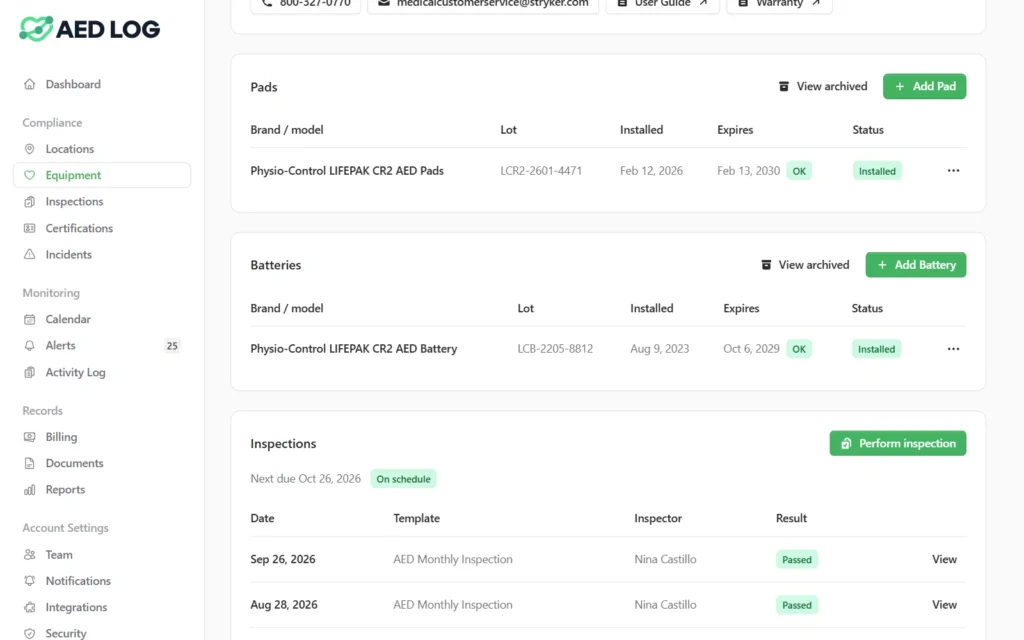
The pads and batteries on an AED in AED Log, each with its lot number, installed date, expiration date and status, above the unit's inspection schedule
An AED’s pads and batteries in AED Log, each with its lot number, installed date and expiration date.

HeartStart FR2 FAQ

How long do HeartStart FR2 pads last?

Philips's FR2+ manual doesn't state a shelf life for the HeartStart adult pads (989803158211) or the M3870A child pads, so go by the date printed on each package. Philips took its last US orders for both on December 31, 2020.

How long does the HeartStart FR2 battery last?

The M3863A battery typically keeps 5 years from manufacture in its packaging, and once installed it typically lasts 5 years, at least 4. Install it before the date on its label. Philips's last US battery orders closed December 31, 2020.

Can you use the HeartStart FR2 on a child?

Yes, with M3870A infant/child reduced-energy pads, for a child who looks younger than 8 or weighs under 55 pounds (25 kg). The pads cut the shock to 50 joules. Without them, use adult pads and don't delay treatment.

What is the difference between the HeartStart FR2 and FR2+?

The FR2+ is Philips's enhanced version of the original Heartstream FR2, with all of its features. Every FR2 accessory works in the FR2+, but FR2+-only parts such as the M3848A rechargeable battery don't work in the FR2. Both use model numbers M3860A and M3861A.

Can you still get pads and batteries for the HeartStart FR2?

Not from Philips in the US. Its last day for US orders of FR2 pads and batteries was December 31, 2020, with no US shipments after February 2, 2021. The FDA warns that accessories for AEDs it hasn't approved, like the FR2, may no longer be available.

Keep every AED ready

AED Log tracks inspections, pads, batteries, certifications and incidents for every AED, whatever the brand.

45 days free. No credit card required. Then plans from $114 a year.