
What OSHA requires in an emergency action plan
OSHA’s standard, 29 CFR 1910.38, applies whenever another OSHA standard requires an emergency action plan. The plan must cover at least six procedures, an alarm system, trained evacuation helpers and a review with each employee.
- 1910.38(c)(1): How employees report fires and other emergencies.
- 1910.38(c)(2): How to evacuate, including the type of evacuation and which exit routes people use.
- 1910.38(c)(3): What employees who stay to run or shut down critical operations do before they leave.
- 1910.38(c)(4): How to account for every employee after the evacuation.
- 1910.38(c)(5): What employees with rescue or medical duties do.
- 1910.38(c)(6): Who employees can ask, by name or job title, about the plan or their own duties under it.
- 1910.38(d): An employee alarm system, with a distinct signal for each purpose, that meets 29 CFR 1910.165.
- 1910.38(e): People designated and trained to help others evacuate safely.
- 1910.38(f): A review of the plan with each employee it covers: when the plan is first written or they start, when their duties under it change, and when the plan changes.
The plan must be in writing, kept at the workplace and available for employees to read. With 10 or fewer employees, OSHA lets you share the plan by word of mouth instead of in writing, under 1910.38(b).
When is a plan required? OSHA’s own guide lists the general industry standards that call for one, including the rules for portable fire extinguishers (1910.157), fixed extinguishing systems (1910.160), fire detection systems (1910.164), process safety management (1910.119), hazardous waste operations and emergency response (1910.120) and grain handling (1910.272). OSHA’s Evacuation Plans and Procedures eTool puts it more simply: if extinguishers are required or provided and anyone will evacuate, you need a plan, which covers almost every business.
What the template includes
The template has nine sections over four pages. Each of the first eight covers one part of 1910.38, cited beside its heading, and the ninth holds your emergency phone numbers.
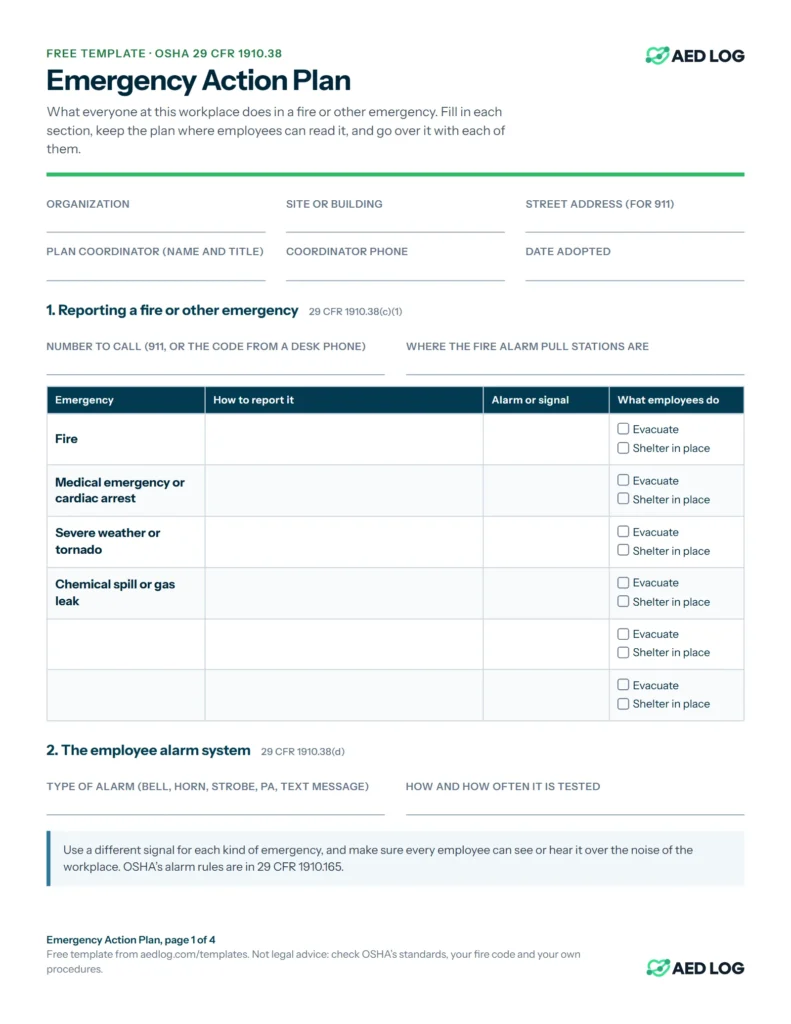
- Reporting a fire or other emergency: the number to call, where the pull stations are, and for fires, medical emergencies, severe weather, chemical spills and two of your own, how to report each, its alarm and whether people evacuate or shelter in place.
- The employee alarm system: the type of alarm and how it’s tested.
- Evacuation routes and procedures: the type of evacuation, each area’s exit routes and assembly area, and your evacuation wardens.
- Critical operations before evacuating: equipment someone shuts down, who does it and when they leave.
- Accounting for everyone: the assembly areas, who takes the head count and who reports anyone missing.
- Rescue and medical duties: trained employees and their CPR, AED and first aid training, and where the AEDs and first aid kits are.
- Who to contact about the plan: names or job titles, phones and emails.
- Training and reviewing the plan: a log of each employee review and why it happened.
- Emergency phone numbers: 911, your building manager, utilities and poison control.
The PDF has form fields over every blank, so you can type into it in a PDF reader, save it and print it, or print it blank and write by hand.
How to fill in your emergency action plan
Walk the building first, then fill in the plan section by section with the people who know each area. Attach a floor plan, get the plan approved, and go over it with every employee.
- Download the PDF and open it in a PDF reader to type into it, or print it and write by hand.
- Fill in your organization, site, street address for 911, plan coordinator and the date you adopt the plan.
- Section 1: say how employees report each kind of emergency, the alarm or signal they’ll hear, and whether they evacuate or shelter in place.
- Section 2: describe the alarm system and how often it’s tested.
- Section 3: list each area’s main and second exit routes and its assembly area, name your evacuation wardens, and attach a floor plan.
- Section 4: list any equipment someone must shut down before leaving, who does it and when they leave.
- Sections 5 to 7: say how you’ll account for everyone, who has rescue and medical duties (with their CPR and AED training), where the AEDs and first aid kits are, and who to contact about the plan.
- Sections 8 and 9: review the plan with each employee and record it, fill in the emergency numbers, and have the plan approved and dated.
OSHA’s eTool suggests going further than the minimum: decide when to evacuate and when to shelter in place, set a chain of command that says who can order an evacuation, plan help for people with disabilities and people who don’t speak English, list where to shut off the utilities, have visitors and contractors sign in so they can be counted, and post floor plans showing the exits, assembly points and emergency equipment. It suggests about one evacuation warden for every 20 employees.
Training employees and reviewing the plan
OSHA requires you to designate and train people to help others evacuate, and to go over the plan with each employee it covers when it’s written or they start, when their duties change, and whenever the plan changes.
Section 8 of the template is a log for those reviews: the date, who was trained, the reason and who led it. OSHA’s eTool also recommends retraining employees every year and holding evacuation drills, then reviewing each drill to see what to fix.
Test the alarm system too. OSHA’s alarm standard, 29 CFR 1910.165, says every employee in the affected area must be able to perceive the alarm above the normal noise and light, with tactile devices for anyone who can’t see or hear it. Systems that aren’t supervised must be tested at least every two months, and supervised systems at least once a year. Where employees report emergencies by phone, post the emergency numbers near the phones.
Adding medical emergencies and AEDs to the plan
An emergency action plan must cover employees with rescue or medical duties, so it’s the natural place to say who is trained in CPR and AED use and where every AED and first aid kit is.
OSHA’s eTool notes that serious injuries need treatment within 3 to 4 minutes, and suggests training people on site in first aid when no clinic or hospital is close. Sudden cardiac arrest is the clearest case: the faster an AED reaches the person, the better their chance. List your trained responders and when their cards expire in section 6, and mark the AEDs on the floor plans you post.
For the cardiac emergency itself, our free cardiac emergency response plan template covers the response team, AED placement and upkeep, drills and what to do after a use. OSHA doesn’t require workplace AEDs, though it recommends them; see OSHA AED requirements for what the rules say and workplace AED programs for how to run one.
Track your emergency equipment automatically
An emergency action plan only works if the equipment it points to is ready. AED Log keeps every AED, fire extinguisher, first aid cabinet and eyewash station on a schedule, and every responder’s certification current.
- Monthly AED inspections, with pad and battery expirations tracked and alerts before they lapse.
- Monthly fire extinguisher checks, with the annual service and hydrostatic test dates.
- First aid cabinet and eyewash station inspections on their own schedules.
- CPR and AED certifications for every responder in section 6 of your plan, with a reminder before each expires.
- A document library for the plan itself, with an expiration date to prompt the yearly review.
AEDs are included in every plan, from $114 a year; other equipment types are add-ons. See every equipment type and document management.