

Cardiac Science Powerheart G5 part numbers and shelf life
These are the parts a Powerheart G5 owner replaces, with the model numbers from ZOLL's user's guide. All three pad types share the same 24-month shelf life.
| Part | Part number | Shelf life | Replace |
|---|---|---|---|
| Intellisense adult pads Adults, preinstalled | XELAED001 | 24 months | By the use-by date, or after any rescue |
| Intellisense adult pads with CPR feedback device (ICPR) Adults, with CPR feedback | XELAED002 | 24 months | By the use-by date, or after any rescue |
| Intellisense pediatric pads Children 8 or younger or 55 lb or less | XELAED003 | 24 months | By the use-by date, or after any rescue |
| Intellisense lithium battery Battery (non-rechargeable) | XBTAED001A | 4 years installed (5-year shelf life before installation) | After about 4 years installed, or when the red gauge LED lights |
The FDA's list of approved accessories adds letter suffixes to these pad numbers (for example XELAED001A), so the number on your package may end in a letter. ZOLL doesn't say whether the 24-month pad life counts from manufacture, so go by the use-by date the AED shows through the lid.
Need replacements? Total AEDs, AED Log’s sister store, sells pads, batteries and the AED itself for the Cardiac Science Powerheart G5. Any authorized distributor works; the FDA advises buying AED accessories only from authorized sources.
Cardiac Science Powerheart G5 self-test and status indicator
The Powerheart G5 tests itself daily, weekly and every 28 days, and runs a shorter check whenever the lid closes. A green Rescue Ready indicator means it's ready; red with a beep every 30 seconds means it found a problem.
The daily self-test checks the battery, pads, electronics and buttons. The weekly test adds a partial high-voltage charge and checks the CPR feedback device. The monthly test, every 28 days, charges to full energy and tests the battery under load. A shorter test runs each time the lid closes.
If the Rescue Ready indicator is red but the service light is off, close and reopen the lid, then check diagnostic mode by holding both buttons for 3 seconds. A red Rescue Ready indicator together with the red service light means the AED needs authorized service. ZOLL's 2025 correction warns that long exposure to extreme temperature or humidity can make a G5 fail its self-test (Error Code 501), so keep an eye on the results.
If the indicator ever shows a problem, our guide to AED self-test failures and status lights covers what to do first.
Cardiac Science Powerheart G5 maintenance checklist
ZOLL asks Powerheart G5 owners to check the Rescue Ready indicator, the battery gauge, the pads and the prompts at least once a month, and to prepare the AED again after every rescue.
- The Rescue Ready indicator is green and the AED isn't beeping.
- The battery gauge shows green LEDs, not the red one.
- The pad date shows in the lid window and hasn't passed, and the pad package is sealed and undamaged.
- With the lid open, the voice prompts and display work, and every LED and button lights.
- Any XELAED003 pediatric pads are sealed and in date, and stored unplugged.
- The AED stays between 68 and 86°F (20 and 30°C), the range ZOLL tested for long-term standby.
After the Cardiac Science Powerheart G5 is used
- Open the lid and, if you want a record, download the rescue data.
- Fit and connect a new pair of adult pads.
- Check that the pad and service lights are off and the battery gauge shows charge.
- Close the lid and confirm the Rescue Ready indicator is green.
Print our free AED inspection checklist to record each check, or read the full AED maintenance guide.
Cardiac Science Powerheart G5 recalls
The FDA's recall database shows three Powerheart G5 recall events since 2019. Two are still open: a 2025 correction for self-test failures after long exposure to extreme temperature or humidity, and a 2024 notice about shipping film left on semi-automatic units.
| Date | Product | Class | What it’s about and what to do | Status | FDA record |
|---|---|---|---|---|---|
| Feb 13, 2025 | Powerheart G5 (automatic and semi-automatic models) | II | Storage outside the temperature or humidity range can cause a self-test failure (Error Code 501). Watch self-tests and store within the range on ZOLL’s notice. | Open | Z-1316-2025 |
| May 31, 2024 | Powerheart G5 semi-automatic | II | Shipping film left on the front panel can block the shock button. Peel it off and confirm on ZOLL’s form. | Open | Z-2324-2024 |
| Jun 4, 2019 | Powerheart G5 (5 units) | II | Supplier circuit-board documentation incomplete. | Closed 2021 | Z-1938-2019 |
Every AED recall, by manufacturer, is on our AED recall list.
How AED Log tracks the Cardiac Science Powerheart G5
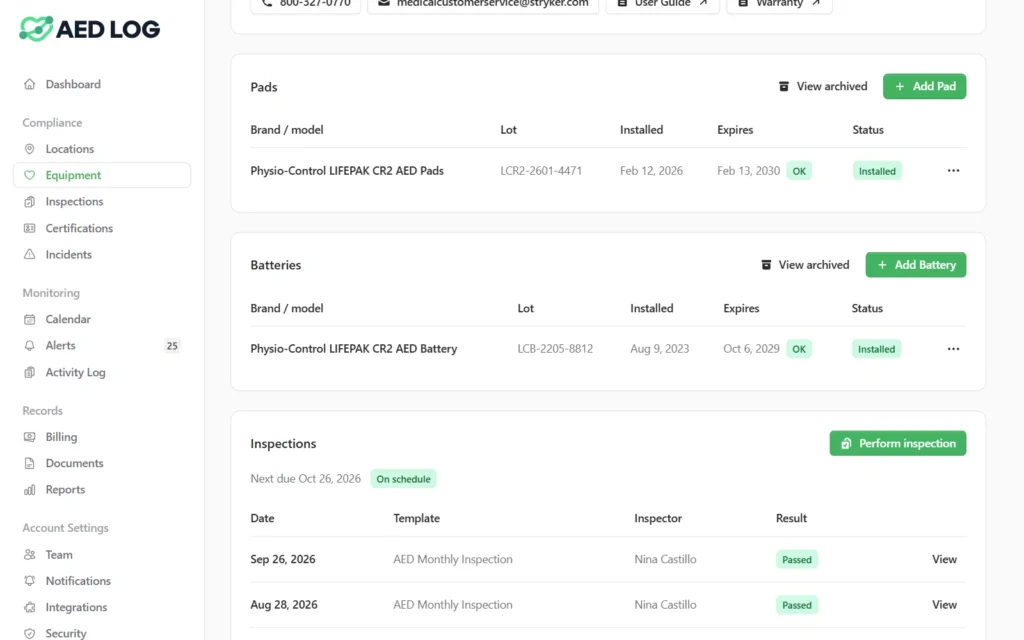
In AED Log you pick the Cardiac Science Powerheart G5 from the built-in catalog, record its pads and battery with their lot numbers and dates, and get a warning before either expires, plus a monthly inspection reminder.
Each pad set and battery is its own record with its own expiration date, so a pad set or battery never lapses unnoticed. Choose the part from the catalog and its shelf life fills in the expiration date for you; you can always type the date printed on the package instead. Alerts go out by email, Slack, Teams or Discord to the people responsible for that site, and the monthly inspection checklist asks about the status indicator, the pads and the battery. See pad and battery expiration tracking and AED management for more, or see every AED model.
Cardiac Science Powerheart G5 FAQ
How long do Cardiac Science Powerheart G5 pads last?
ZOLL gives all three Powerheart G5 pads a 24-month shelf life: XELAED001 adult, XELAED002 adult with CPR feedback, and XELAED003 pediatric. The AED reads the expiration date, which shows through the lid. Replace pads by that date and after every rescue.
How long does the Cardiac Science Powerheart G5 battery last?
The Intellisense lithium battery (XBTAED001A) can wait up to 5 years from its manufacture date before installation, then lasts about 4 years in standby once installed. Replace it sooner if the gauge's red LED lights or the AED says REPLACE BATTERY NOW.
Can you use the Cardiac Science Powerheart G5 on a child?
Yes. ZOLL says to use XELAED003 pediatric pads for a child 8 or younger or 55 pounds or less; they lower the shock energy. If no child pads are available, use the installed adult pads, and don't delay treatment to check age or weight.
Is the Powerheart G5 made by ZOLL or Cardiac Science?
Both, in turn. Cardiac Science developed the G5 and won FDA approval for it in 2018. ZOLL completed its acquisition of Cardiac Science in 2019 and now sells the G5 under the ZOLL name, with its own manuals and recall notices.