
AED model

Cardiac Science Powerheart G3 Plus: Pads, Battery and Maintenance

Kyle Nowack, Co-founder of AED Log

By Kyle Nowack

Co-founder, AED Log

Last reviewed October 13, 2026 · 8 min read

Last reviewed against ZOLL’s own manuals and product pages. Always follow the manual that came with your AED and the dates printed on your own pads and battery.

The short answer

The Powerheart G3 Plus uses model 9131 Intellisense adult pads, model 9730 pediatric attenuated pads for children under 8, and a model 9146 Intellisense lithium battery with a 4-year replacement guarantee once installed. The pad date shows through the lid, and a green Rescue Ready indicator on the handle means it's ready.

Key facts

  • Adult pads: model 9131 (9131-001 on an FDA record); ZOLL doesn't publish a shelf life, so go by the package date.
  • Child pads: model 9730 pediatric attenuated pads, for children under 8 or under 55 pounds.
  • Battery: model 9146 Intellisense lithium, 5-year shelf life before installation and a 4-year full replacement guarantee once installed.
  • A green Rescue Ready indicator on the handle means ready; red means it isn't.
  • ZOLL no longer lists the G3 Plus for sale, and we found no end-of-support notice for models 9390A and 9390E.

Cardiac Science Powerheart G3 Plus at a glance

The Powerheart G3 Plus is a public-access AED made by Cardiac Science, now part of ZOLL, in semi-automatic (9390E) and automatic (9390A) versions. ZOLL no longer lists it for sale but still posts its quick reference guide, and it holds FDA approval from 2018.

Cardiac Science Powerheart G3 Plus at a glance, from ZOLL’s documents.
DetailCardiac Science Powerheart G3 Plus
Made byCardiac Science, now part of ZOLL (acquired 2019)
Versions9390E semi-automatic and 9390A fully automatic
Adult padsIntellisense model 9131; shelf life not published
ChildrenModel 9730 pediatric attenuated pads
BatteryIntellisense lithium 9146, 4-year guarantee once installed
Self-testDaily, weekly and monthly
Ready indicatorGreen Rescue Ready indicator on the handle
StoragePads at room temperature; battery at 32 to 122°F (0 to 50°C)
FDA approvalDecember 7, 2018 (P160033)
StatusNot on ZOLL's current US AED list; no end-of-sale date published

The 9390E is semi-automatic. When a shock is advised, its SHOCK button flashes; if nobody presses it within 30 seconds, the AED disarms and prompts CPR. The 9390A shocks by itself after counting down three, two, one. The FDA's summary describes the G3 Plus as the public-access model that added fully automatic shocks, preconnected pads, prompts paced to the user and CPR coaching to the original G3.

Cardiac Science made the G3 Plus, and ZOLL completed its acquisition of Cardiac Science in 2019. ZOLL no longer lists the G3 Plus among its US AEDs, but it still hosts the quick reference guide and has published no end-of-sale or end-of-support date for the 9390 models; its 2016 end-of-support notice covers only older 9300-series units. Because the G3 Plus holds FDA approval (P160033, 2018), ZOLL's 2022 cutoff for accessories of unapproved AEDs doesn't apply to it.

Powerheart G3 Plus (9390E) and Powerheart G3 Plus Automatic (9390A): how they differ

  • Powerheart G3 Plus (9390E): Semi-automatic: when a shock is needed, the SHOCK button lights up and flashes; if nobody presses it within 30 seconds, the AED disarms and prompts CPR.
  • Powerheart G3 Plus Automatic (9390A): Fully automatic: it delivers the shock itself after counting down three, two, one, with no button to press.

Other Cardiac Science Powerheart (now ZOLL) models we cover: Cardiac Science Powerheart G5 and Cardiac Science Powerheart G3 Pro.

Cardiac Science Powerheart G3 Plus pads

The Powerheart G3 Plus uses model 9131 Intellisense adult pads, kept plugged in with the expiration date showing through the lid. ZOLL doesn't publish a shelf life for them, so replace them by the date on the package and after every use.

The adult pads are Cardiac Science model 9131, the Intellisense Defibrillation Pad. They're non-polarized, so it doesn't matter which pad goes where, and they're single use. Keep a fresh, sealed pair plugged in at all times, and store pads at room temperature. Seat the pad package in the lid so the expiration label shows through the clear window; then the date can be read without opening the AED. If the pads aren't installed properly, the status indicator turns red.

The quick reference says only that the pads have a limited shelf life, printed on the package. ZOLL doesn't publish a figure, so track the date on your own pads.

Using the Cardiac Science Powerheart G3 Plus on children

Yes. For a child under 8 or under 55 pounds (25 kg), use the model 9730 pediatric attenuated pads; if you don't have them, the guide says to use the adult pads.

For a child younger than 8 or weighing less than 25 kg (55 pounds), the quick reference names the model 9730 pediatric attenuated pads. If you don't have pediatric pads, it says to deliver therapy with the adult pads instead. ZOLL doesn't publish a shelf life for the 9730 pads either, so give them a reminder of their own based on the date printed on the package.

For the general rules on child pads, ages and placement, see our guide to pediatric AED pads.

Cardiac Science Powerheart G3 Plus battery

The Powerheart G3 Plus runs on the model 9146 Intellisense lithium battery, which isn't rechargeable. It has a 5-year shelf life before installation and a 4-year full replacement guarantee once installed.

The battery is the model 9146 Intellisense lithium battery, a lithium sulfur dioxide pack that can't be recharged and keeps its own usage history. Its 5-year shelf life, counted from the manufacture date, is how long it can sit at room temperature before installation and still meet its specifications. Once installed, it carries a 4-year full replacement guarantee and gives up to 290 shocks, or at least 14 hours of operation (18 typical) with no shocks.

Keep spare batteries between 32 and 122°F (0 and 50°C); storing them outside that range shortens their life. After fitting a battery, open the lid for 5 seconds to start a self-test, then check that the battery gauge LEDs light and the Rescue Ready indicator turns green. The FDA also lists an aviation version, model 9147-201-TSO.

How other models compare is in our AED battery replacement guide.

Cardiac Science Powerheart G3 Plus part numbers and shelf life

These are the parts a G3 Plus owner replaces, with the model numbers from the Cardiac Science guide that ZOLL now hosts. The same pads fit the G3 and G3 Pro.

Replacement parts for the Cardiac Science Powerheart G3 Plus, with ZOLL’s part numbers and shelf lives (checked October 13, 2026). Go by the date printed on your own parts.
PartPart numberShelf lifeReplace
Intellisense adult pads
Adults (non-polarized)
9131Not stated by ZOLLBy the package date, or after any use
Intellisense pediatric attenuated pads
Children under 8 or under 55 lb
9730Not stated by ZOLLBy the package date, or after any use
Intellisense lithium battery
Battery (non-rechargeable)
91464-year guarantee installed (5-year shelf life before)By the end of its 4-year installed guarantee

The numbers above are Cardiac Science model numbers. An FDA recall record shows the adult pads ordered as 9131-001, so the number on your package may carry a suffix. Neither the quick reference nor any other ZOLL document we checked gives a shelf life for the 9131 or 9730 pads, so the date printed on the package is the one to track.

Need replacements? Total AEDs, AED Log’s sister store, sells pads and batteries for the Cardiac Science Powerheart G3 Plus. Any authorized distributor works; the FDA advises buying AED accessories only from authorized sources.

Cardiac Science Powerheart G3 Plus self-test and status indicator

The Powerheart G3 Plus tests itself daily, weekly and monthly. The Rescue Ready indicator on the handle is green when it passed and red when the AED isn't ready.

Like the rest of the G3 family, the G3 Plus runs automatic self-tests every day, every week and every month, and reports the result with a beep and the Rescue Ready indicator on the handle. The daily test also checks for extreme storage conditions: if the AED has been kept outside its operating range, the indicator can turn red and the AED may call for service.

Green means rescue ready; red means it isn't. A badly seated pad package is one cause of a red indicator. For the AED's standby temperature range, the quick reference points to the full Operator and Service Manual, which isn't posted on zoll.com.

If the indicator ever shows a problem, our guide to AED self-test failures and status lights covers what to do first.

Cardiac Science Powerheart G3 Plus maintenance checklist

Keeping a G3 Plus ready comes down to a green Rescue Ready indicator, in-date pads plugged in with their date visible through the lid, and a battery inside its guarantee. Check them regularly and after every rescue.

  • The Rescue Ready indicator on the handle is green and the AED isn't beeping.
  • A fresh, sealed pair of 9131 pads is plugged in, with its expiration date showing in the lid window and not yet passed.
  • Any 9730 pediatric pads are sealed and within their date.
  • The battery is inside its 4-year guarantee from installation.
  • Spare batteries are kept between 32 and 122°F (0 and 50°C), and spare pads at room temperature.
  • The case is clean and undamaged, and rescue supplies are with the AED.

After the Cardiac Science Powerheart G3 Plus is used

  1. If you need a record of the rescue, download the data with Rescuelink software.
  2. Connect a new pair of pads.
  3. Close the lid.
  4. Check that the status indicator on the handle is green.

Print our free AED inspection checklist to record each check, or read the full AED maintenance guide.

Cardiac Science Powerheart G3 Plus recalls

Every FDA recall we found for the Powerheart G3 Plus or its pads is closed. The most recent, in 2016, covered one lot of 9131 adult pads.

FDA recalls that cover the Cardiac Science Powerheart G3 Plus or its accessories, newest first. From the FDA’s Medical Device Recall database, checked October 12, 2026.
DateProductClassWhat it’s about and what to doStatusFDA record
Jan 14, 20169131-001 adult pads, lot 141125-02 (Powerheart G3, G3 Plus, G3 Pro)IIPad impedance could rise over time until the AED failed its pad self-test, with a red status indicator and beeping. Pads from that lot were replaced.Closed 2016Z-0829-2016
Jan 13, 2012Powerheart G3 9300A/E/P and G3 Plus 9390A/E (listed serial numbers)IA circuit-board part could fail and stop the AED from shocking. Affected units went back to Cardiac Science for repair.Closed 2013Z-1057-2012
Nov 13, 2009Powerheart G3 Plus 9390AIA resistor problem could keep the AED from delivering therapy. Owners were sent preventive steps.Closed 2014Z-0770-2010
Oct 12, 2009Powerheart G3 9300A/C/D/E/P and 9390A/E made October 2003 to February 2009ISome units may have shipped without adequate electrical safety testing. Owners were asked to arrange a replacement.Closed 2012Z-1424-2010

Every AED recall, by manufacturer, is on our AED recall list.

How AED Log tracks the Cardiac Science Powerheart G3 Plus

In AED Log you pick the Cardiac Science Powerheart G3 Plus from the built-in catalog, record its pads and battery with their lot numbers and dates, and get a warning before either expires, plus a monthly inspection reminder.

Each pad set and battery is its own record with its own expiration date, so a pad set or battery never lapses unnoticed. Choose the part from the catalog and its shelf life fills in the expiration date for you; you can always type the date printed on the package instead. Alerts go out by email, Slack, Teams or Discord to the people responsible for that site, and the monthly inspection checklist asks about the status indicator, the pads and the battery. See pad and battery expiration tracking and AED management for more, or see every AED model.
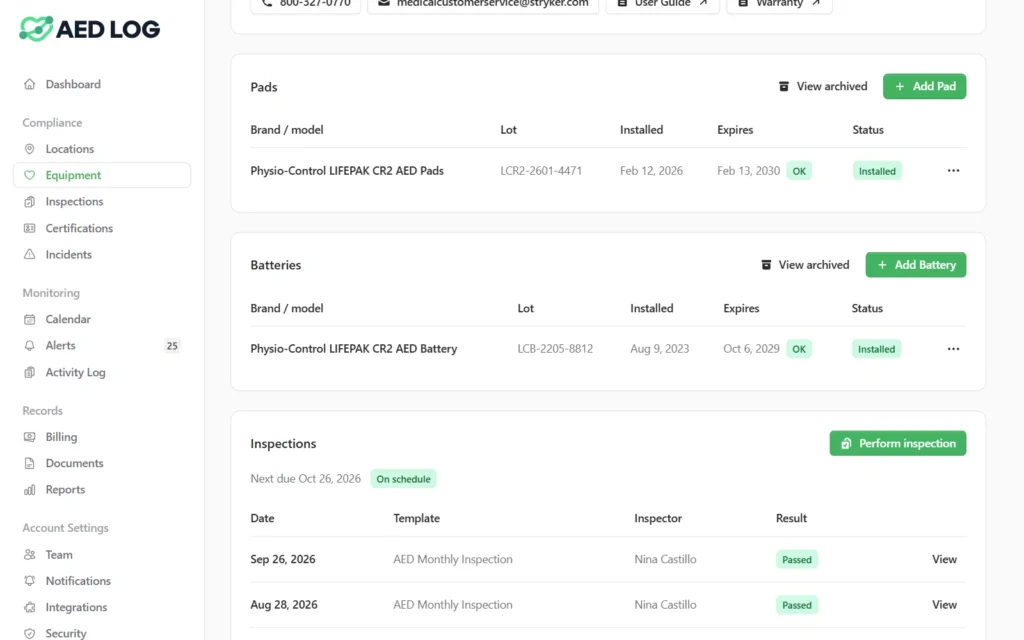
The pads and batteries on an AED in AED Log, each with its lot number, installed date, expiration date and status, above the unit's inspection schedule
An AED’s pads and batteries in AED Log, each with its lot number, installed date and expiration date.

Cardiac Science Powerheart G3 Plus FAQ

How long do Cardiac Science Powerheart G3 Plus pads last?

ZOLL doesn't publish a shelf life for the G3 Plus pads, model 9131 adult and 9730 pediatric. Each package carries an expiration date, visible through the lid window: replace the pads by that date and after every use.

How long does the Cardiac Science Powerheart G3 Plus battery last?

The model 9146 Intellisense lithium battery has a 5-year shelf life from its manufacture date before installation, then a 4-year full replacement guarantee once installed, with up to 290 shocks.

Can you use the Cardiac Science Powerheart G3 Plus on a child?

Yes. For a child under 8 or under 55 pounds (25 kg), use model 9730 pediatric attenuated pads. If no pediatric pads are available, the guide says to use the adult pads.

Is the Powerheart G3 Plus discontinued?

ZOLL no longer lists it among its US AEDs but hasn't announced an end-of-sale or end-of-support date for models 9390A and 9390E. It holds FDA approval, and ZOLL still posts its quick reference guide.

Keep every AED ready

AED Log tracks inspections, pads, batteries, certifications and incidents for every AED, whatever the brand.

45 days free. No credit card required. Then plans from $114 a year.