

Lifeline VIEW part numbers and shelf life
These are the parts a Lifeline VIEW or ECG owner replaces, with Defibtech's part numbers and stated lives. Both models take the same pads and battery packs.
| Part | Part number | Shelf life | Replace |
|---|---|---|---|
| Adult Defibrillation Pads Adults, and children 8 and up or over 55 lb | DDP-2001 | 2.5 years from manufacture | By the date on the pouch or status screen, or after any use |
| Child/Infant Defibrillation Pads A child younger than 8 or lighter than 55 lb | DDP-2002 | 2.5 years from manufacture | By the date on the pouch or status screen, or after any use |
| Lithium battery pack Battery, 125 shocks (sold as DCF-2003) | DBP-2003 | 4 years in standby | By the date on its label, or when the AED asks |
| Aviation battery pack Battery for use on commercial aircraft (kit DCF-2013) | DBP-2013 | 4 years in standby | By the date on its label, or when the AED asks |
Defibtech's undated online catalog gives 2 years for both pad sets; the figures above are from the July 2026 user manual. You need the DBP-2013 only if the AED flies on commercial aircraft.
Need replacements? Total AEDs, AED Log’s sister store, sells pads, batteries and the AED itself for the Lifeline VIEW. Any authorized distributor works; the FDA advises buying AED accessories only from authorized sources.
Lifeline VIEW self-test and status indicator
The Lifeline VIEW checks itself whenever it's switched on and runs its own daily, weekly, monthly and quarterly tests. A single green flash from the status light means ready; red double flashes with double beeps, or no light at all, mean it needs service.
Along with the power-on check and the daily, weekly, monthly and quarterly tests, the AED tests a battery pack when it goes in, provided the pack has been out for at least 10 seconds. The tests look at the buttons and controls, battery condition, the charge and discharge circuits, and ECG signal measurement. For a manual test, start with the AED off, tap the center softkey to bring up the status screen, then choose the tool icon, AED maintenance and Perform AED test. A pass ends with "AED OK".
Opening that screen doesn't start a rescue, and it lists the AED's condition, the battery and pad expiry dates, the serial numbers and the software version. The status light uses one green flash for ready and two red flashes for trouble, which helps people with color blindness. On software 2.7 or later it can also radio its status to optional remote-monitoring equipment at every power-down, automatic tests included. That feature is off until enabled in Maintenance Mode; the FDA approved its labeling in June 2026.
If the indicator ever shows a problem, our guide to AED self-test failures and status lights covers what to do first.
Lifeline VIEW maintenance checklist
Defibtech's sample schedule has you check the status light daily, check the AED, its accessories and their dates regularly, and, if you use it, confirm readiness through remote monitoring. Its checklist also asks for a spare battery pack and spare pads.
- The status light gives a single green flash, with no red flashes or double beeps.
- The adult pads are plugged in, their pouch is sealed in the slot on the back, and its date hasn't passed.
- Any DDP-2002 child/infant pads are sealed, in date and kept near the AED.
- The battery pack is within its printed expiration date (the status screen shows it next to the pad date).
- If you use remote monitoring, it reports the AED as ready.
- The AED is clean and undamaged and kept within 32 to 122°F (0 to 50°C), where its light can be seen and its beeps heard.
- Spares are ready, per Defibtech's checklist: one battery pack and one set of pads.
After the Lifeline VIEW is used
- Clean the AED.
- Connect a new, in-date adult pads package.
- Run a manual self-test from Maintenance Mode.
- Switch the AED off and check for the single green flash.
Print our free AED inspection checklist to record each check, or read the full AED maintenance guide.
Lifeline VIEW recalls
The FDA's recall database lists one recall of the Lifeline VIEW and ECG that reached US owners: a 2020 Class II correction for a component problem that could abort a shock or reset the AED, closed in 2021. Defibtech's 2020 safety alert page still offers a serial-number check; the 9-digit serial label sits under the pads in the rear pouch.
| Date | Product | Class | What it’s about and what to do | Status | FDA record |
|---|---|---|---|---|---|
| Apr 27, 2020 | Lifeline VIEW, PRO and ECG | II | A component issue can abort a shock or reset the AED. | Closed 2021 | Z-2392-2020, Z-2394-2020 |
Every AED recall, by manufacturer, is on our AED recall list.
How AED Log tracks the Lifeline VIEW
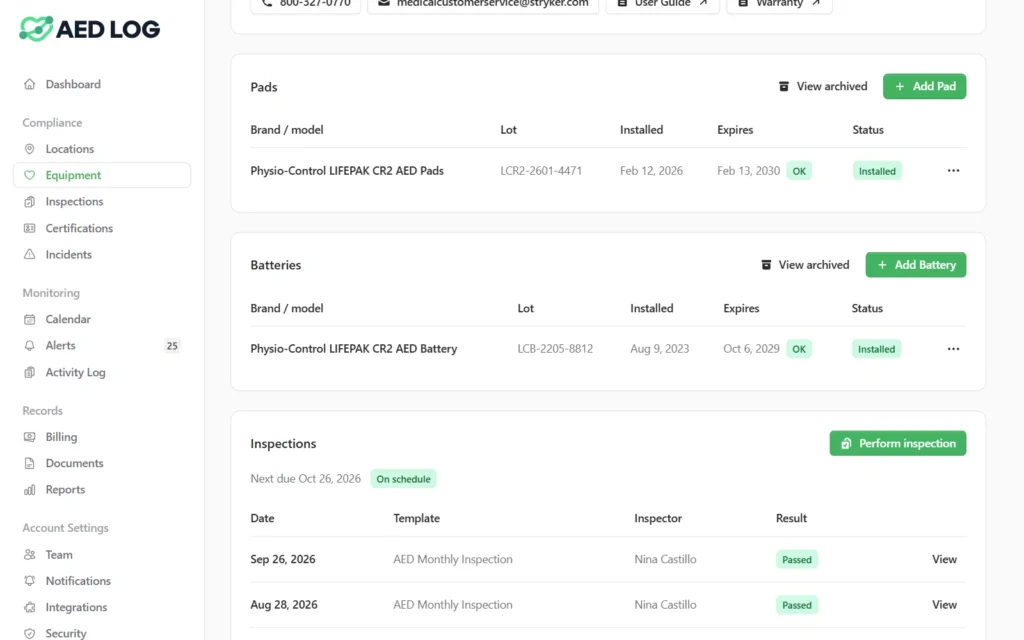
In AED Log you pick the Lifeline VIEW from the built-in catalog, record its pads and battery with their lot numbers and dates, and get a warning before either expires, plus a monthly inspection reminder.
Each pad set and battery is its own record with its own expiration date, so a pad set or battery never lapses unnoticed. Choose the part from the catalog and its shelf life fills in the expiration date for you; you can always type the date printed on the package instead. Alerts go out by email, Slack, Teams or Discord to the people responsible for that site, and the monthly inspection checklist asks about the status indicator, the pads and the battery. See pad and battery expiration tracking and AED management for more, or see every AED model.
Lifeline VIEW FAQ
How long do Lifeline VIEW pads last?
Defibtech's July 2026 manual dates DDP-2001 adult and DDP-2002 child/infant pads 2.5 years from manufacture; its online catalog says 2 years. Follow the date on the pouch or the AED's status screen, and replace the pads after any use.
How long does the Lifeline VIEW battery last?
The DBP-2003 battery pack lasts about 4 years installed, with the automatic self-tests already allowed for, and is rated at 125 shocks. Replace it by the date on its label or when the AED asks. Frequent manual self-tests shorten its life.
Can you use the Lifeline VIEW on a child?
Yes. For a child younger than 8 or lighter than 55 lb, plug in DDP-2002 child/infant pads; the AED announces Pediatric mode and gives 50 joules instead of 150. If none are available, Defibtech says to go ahead with the adult pads instead of waiting.
What is the difference between the Lifeline VIEW and Lifeline ECG?
Both are semi-automatic AEDs with a video screen, and they share pads and batteries. The Lifeline ECG (DDU-2450) adds a Mode Select softkey that shows the patient's rhythm, heart rate and shock count. That view is non-diagnostic and has no alarms.
Does the Lifeline VIEW have a 9V battery?
No. The status light draws its power from the main DBP-2003 battery pack, so if that pack is flat or missing, the light stays dark. That's one reason a status light showing no flash at all needs checking right away.