

Defibtech Lifeline part numbers and shelf life
These are the parts a Lifeline or Lifeline AUTO owner replaces, with Defibtech's part numbers and stated lives. Both versions take the same parts, so one set of spares fits either.
| Part | Part number | Shelf life | Replace |
|---|---|---|---|
| Adult Defibrillation Pads Adults, and children 8 and up or over 55 lb | DDP-100 | 2.5 years from manufacture | By the date on the pouch, or after any use |
| Child/Infant Defibrillation Pads A child younger than 8 or lighter than 55 lb; software 1.203 or later | DDP-200P | 2.5 years from manufacture | By the date on the pouch, or after any use |
| Standard Lithium Battery Pack Battery, 125 shocks (sold as kit DCF-200 with a DAC-410) | DBP-1400 | 5 years in standby | By the date on its label, or when the AED asks |
| High-Capacity Lithium Battery Pack Battery, 300 shocks (sold as kit DCF-210 with a DAC-410) | DBP-2800 | 7 years in standby | By the date on its label, or when the AED asks |
| 9V Lithium Battery Runs the status light; fits inside the battery pack | DAC-410 | About 1 year installed | Whenever you change the pads |
Defibtech's undated online catalog gives 2 years for both pad sets; the figures above are from the 2021 user manual. Older packs that lack the marking pictured in the manual will run the AED in a rescue but shouldn't be left in it on standby, and the AED announces them as an unknown battery type. Defibtech's limited warranty runs 8 years on the AED and 4 years on the battery, never past the battery's printed date.
Need replacements? Total AEDs, AED Log’s sister store, sells pads, batteries and the AED itself for the Defibtech Lifeline. Any authorized distributor works; the FDA advises buying AED accessories only from authorized sources.
Defibtech Lifeline self-test and status indicator
The Lifeline checks itself each time it's switched on and runs its own daily, weekly, monthly and quarterly tests. A green blink from the status light means it's switched off and ready; a red blink with periodic beeps means it needs attention.
Besides the power-on check, the Lifeline runs daily, weekly, monthly and quarterly self-tests on its own, and a system test whenever a battery pack goes in. Defibtech's spec sheet adds that connected pads are checked daily. For a test on demand, start with the AED switched off and press and hold ON/OFF for roughly 5 seconds, until the AED says it's testing. It charges and fires internally and says "AED OK" if all is well. Each manual test costs one shock of battery, but Defibtech does call for one after the AED has been dropped or mishandled.
The status light is in the upper corner and blinks green about every 5 seconds when the AED is off and ready. A red blink, with beeps, means the AED or its battery needs attention. If the light is dark, either there's no working battery pack in it or the AED has a fault. To hear the cause, switch the AED on, then hold ON/OFF for about 2 seconds to turn it off; it names the problem as it powers down.
If the indicator ever shows a problem, our guide to AED self-test failures and status lights covers what to do first.
Defibtech Lifeline maintenance checklist
Defibtech's sample schedule starts with a daily look for the green blink, plus regular checks of the AED, its accessories and their dates. Your AED program's medical director has the last word on the schedule.
- The status light blinks green and the AED isn't beeping (Defibtech suggests checking daily).
- The adult pads are plugged in, their pouch is sealed and tucked in the back, and its date hasn't passed.
- Any DDP-200P child/infant pads are sealed, in date and kept near the AED, not connected.
- The battery pack is within the expiration date on its label, and the DAC-410 9V was changed with the last pads.
- The case is clean and undamaged, and the AED is kept within 32 to 122°F (0 to 50°C), where its light can be seen and its beeps heard.
- A spare battery pack and a spare set of pads are on hand, as Defibtech's checklist asks.
After the Defibtech Lifeline is used
- Remove the battery pack, and the data card if one is fitted.
- Connect a new, in-date set of pads and store them in the pouch on the back.
- Put the battery pack back and check that its insertion test passes.
- Run a manual self-test, then confirm the status light blinks green.
Print our free AED inspection checklist to record each check, or read the full AED maintenance guide.
Defibtech Lifeline recalls
The FDA's recall database lists one open recall of the Lifeline, a 2023 Class II action covering 29 units, and three Class I recalls from 2007 to 2011 that are all closed.
| Date | Product | Class | What it’s about and what to do | Status | FDA record |
|---|---|---|---|---|---|
| Feb 14, 2023 | Lifeline DDU-100 (29 units) | II | A component hadn’t completed reliability testing. Compare your serial number with the list and set aside affected AEDs. | Open | Z-1312-2023 |
| Apr 1, 2011 | Lifeline and ReviveR DDU-100 series, software 2.004 or earlier | I | Software on affected units could cancel a shock while the AED was charging. Owners were sent a software update. | Closed 2021 | Z-2064-2011 |
| May 21, 2010 | Lifeline DDU-100 used with DBP-2800 battery packs shipped before June 4, 2007 | I | With an affected DBP-2800 pack the AED could falsely detect an error, cancel the charge and give no shock. | Closed 2020 | Z-1781-2010 |
| Feb 17, 2007 | Lifeline DDU-100A, software 2.002 and earlier | I | A self-test could clear an earlier low-battery warning, so the AED might be unable to shock without the owner knowing. | Closed 2021 | Z-0580-2007 |
Every AED recall, by manufacturer, is on our AED recall list.
How AED Log tracks the Defibtech Lifeline
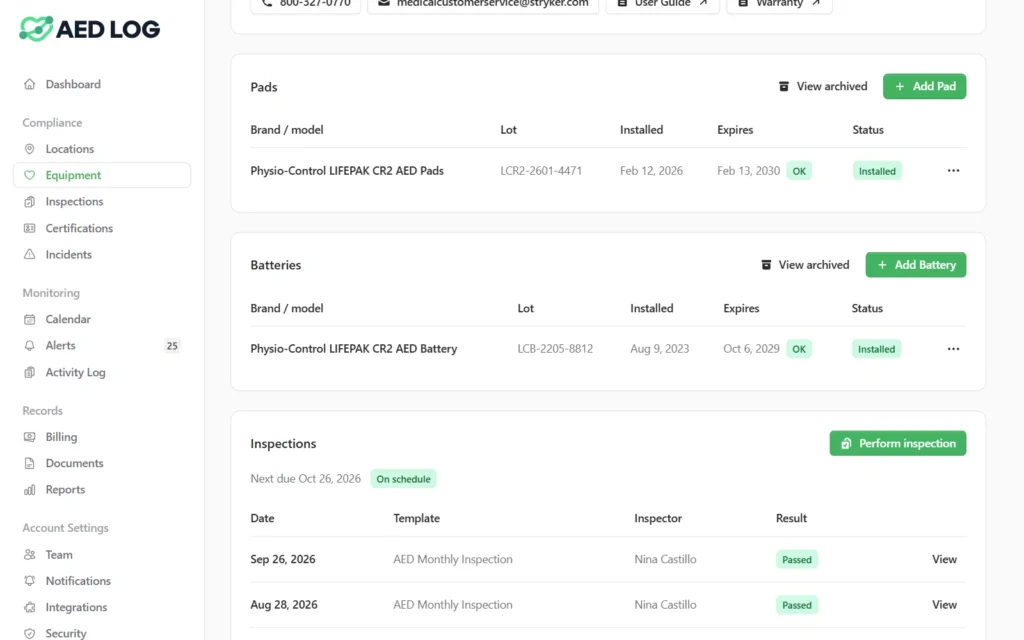
In AED Log you pick the Defibtech Lifeline from the built-in catalog, record its pads and battery with their lot numbers and dates, and get a warning before either expires, plus a monthly inspection reminder.
Each pad set and battery is its own record with its own expiration date, so a pad set or battery never lapses unnoticed. Choose the part from the catalog and its shelf life fills in the expiration date for you; you can always type the date printed on the package instead. Alerts go out by email, Slack, Teams or Discord to the people responsible for that site, and the monthly inspection checklist asks about the status indicator, the pads and the battery. See pad and battery expiration tracking and AED management for more, or see every AED model.
Defibtech Lifeline FAQ
How long do Defibtech Lifeline pads last?
Defibtech's user manual dates DDP-100 adult and DDP-200P child/infant pads 2.5 years from manufacture, while its online catalog says 2 years. Go by the expiration date printed on the pouch, and replace the pads after any use.
How long does the Defibtech Lifeline battery last?
The standard DBP-1400 pack lasts about 5 years in standby and the high-capacity DBP-2800 about 7, with the 9V battery fitted. Replace either by the date on its label. Change the DAC-410 9V battery that runs the status light with the pads.
Can you use the Defibtech Lifeline on a child?
Yes. For a child younger than 8 or lighter than 55 lb, use DDP-200P child/infant pads, which lower the shock to 50 joules; they need software 1.203 or later. If none are on hand, Defibtech says to go ahead with the adult pads instead of waiting.
What is the difference between the Defibtech Lifeline and Lifeline AUTO?
The Lifeline (DDU-100) is semi-automatic: the rescuer presses the flashing SHOCK button. The Lifeline AUTO (DDU-120) has only an ON/OFF button and shocks by itself after a spoken countdown. Both use the same pads, batteries and self-tests.
What is the 9V battery in a Defibtech Lifeline for?
The DAC-410 9V lithium battery fits inside the main battery pack and runs the status light. It lasts about a year installed, and Defibtech says to change it with the pads. The AED works without it, but the main pack runs down sooner.