

HeartSine samaritan PAD part numbers and shelf life
Samaritan PAD owners replace whole Pad-Paks, not separate pads and batteries. Here are HeartSine's part numbers and shelf lives for the cartridges that fit all 3 models.
| Part | Part number | Shelf life | Replace |
|---|---|---|---|
| Pad-Pak Patients over 8 or over 55 lb; pads and battery in one cartridge (gray) | PAD-PAK-01 | 4 years from manufacture | By the expiration date on the back, or after any use |
| Pediatric-Pak Children 1 to 8 or up to 55 lb; child pads and battery in one cartridge (pink) | PAD-PAK-02 | Not stated by Stryker or HeartSine | By the expiration date printed on it, or after any use |
| Aviation Pad-Pak Adult Pad-Pak certified for use on commercial aircraft | PAD-PAK-07 | Not stated by Stryker or HeartSine | By the expiration date printed on it, or after any use |
AED Log's catalog lists HeartSine's Pediatric-Pak as "Pediatric Pad-Pak". Standard AED simulators and training manikins can't test HeartSine units, so ask HeartSine or a distributor if you need one tested.
Need replacements? Total AEDs, AED Log’s sister store, sells pads and the AED itself for the HeartSine samaritan PAD. Any authorized distributor works; the FDA advises buying AED accessories only from authorized sources.
HeartSine samaritan PAD self-test and status indicator
The samaritan PAD tests itself once a week, on Sunday. Its status light flashes green every 5 to 10 seconds when it's ready; a red flash, no light or a beep that won't stop means it needs attention.
The AED runs its self-test every Sunday, and also whenever a Pad-Pak is inserted. HeartSine's manuals disagree on the hour: the 2022 350P manual says 7 p.m. Eastern, while the 360P and 450P manuals say midnight GMT. While the test runs, the status light blinks red, and it goes back to green if the test passes.
If the light flashes red, goes dark, or the AED beeps without stopping, check the Pad-Pak's expiration date first, then switch the AED on and listen for its warnings. 3 quick beeps while it's off mean it's colder than 32°F (0°C) or hotter than 122°F (50°C); move it somewhere within range and make sure the beeping stops. If it got below freezing in transit, give it at least 24 hours back in range before relying on it.
If the indicator ever shows a problem, our guide to AED self-test failures and status lights covers what to do first.
HeartSine samaritan PAD maintenance checklist
HeartSine says the samaritan PAD needs no servicing because it tests itself weekly, but owners should still check the status light every week, look over the AED and the Pad-Pak date monthly, and do a power-on check every 3 months.
- Weekly: the status light flashes green every 5 to 10 seconds, with no red flash and no beeping.
- Monthly: the case has no cracks, and the Pad-Pak's electrode drawer (green tab) is undamaged and closes properly.
- Monthly: the Pad-Pak's expiration date on the back hasn't passed and isn't close; replace it if it is.
- Every 3 months: turn the AED on, listen for the voice prompts, turn it off and confirm the green flash returns (HeartSine's 2024 maintenance supplement).
- Any Pediatric-Pak kept with the AED is sealed and within its printed date.
- The AED stays between 32 and 122°F (0 and 50°C).
After the HeartSine samaritan PAD is used
- Fit a new Pad-Pak, or a new Pediatric-Pak if a child's was used.
- Clean the AED with soapy water or 70% isopropyl alcohol if needed, and check it for damage.
- Confirm the status light flashes green.
- Dispose of the used pads as infectious waste and recycle the battery separately.
- Send the event data to Stryker (downloaded with Saver EVO software and USB cable PAD-ACC-02); you may qualify for a free replacement Pad-Pak.
Print our free AED inspection checklist to record each check, or read the full AED maintenance guide.
HeartSine samaritan PAD recalls
The FDA's recall database lists a number of recalls of the 350P, 360P and 450P and of Pad-Pak cartridges, and several were still open when we checked. Compare your serial number and Pad-Pak lot with the notices below.
| Date | Product | Class | What it’s about and what to do | Status | FDA record |
|---|---|---|---|---|---|
| Jul 27, 2026 | samaritan PAD 350P, 360P, 450P | II | An internal fault can leave the AED unable to charge or shock. Check your serial number in HeartSine’s recall lookup. | Open | Z-3120-2026 |
| Jul 27, 2026 | samaritan PAD 350P, 360P, 450P | III | Some units shipped without a required maintenance supplement. Check your serial number (choose “AED + Pad-Pak”) and keep the insert with the manual. | Open | Z-3270-2026 |
| Sep 18, 2025 | Pad-Pak cartridges | II | Bent locator pins can affect the cartridge’s fit and contact. Check the pins and the expiry date, and respond online. | Open | Z-0288-2026 |
| Jun 30, 2025 | samaritan PAD 350P, 360P, 450P (some serial numbers) | II | A circuit-board issue can make the AED fail while charging or shocking. Check your serial number; Stryker says to keep using the unit if you have no other AED. | Open | Z-2174-2025 |
| Apr 8, 2024 | samaritan PAD 350P, 360P, 450P | II | Voice prompts can stop working. Insert an in-date Pad-Pak, press On and listen; call support if there’s no prompt. | Open | Z-1820-2024 |
| Feb 14, 2024 | samaritan PAD (12 units) | II | Units shipped in a test configuration. Return the acknowledgment form. | Open | Z-1141-2024 |
| Apr 26, 2023 | Pad-Pak cartridges (specific lots) | II | Depleted battery cells can leave no power to shock. Check your lot numbers for a free replacement. | Open | Z-2143-2023 |
| Feb 1, 2023 | samaritan PAD 350P, 360P, 500P (13 units) | II | Wrong voice-prompt language. Run the language check in the notice. | Open | Z-1217-2023 |
| Jan 13, 2022 | samaritan PAD 350P (1 unit) | III | Shipped without its Pad-Pak. | Closed 2023 | Z-0745-2022 |
| Jun 12, 2014 | Pad-Pak and Pedi-Pak (listed lots) for the samaritan PAD 300P and 350P | II | Some sealed pad pouches were hard to open, which could delay treatment. Affected lots were returned through distributors for replacements. | Closed 2015 | Z-2115-2014 |
Every AED recall, by manufacturer, is on our AED recall list.
How AED Log tracks the HeartSine samaritan PAD
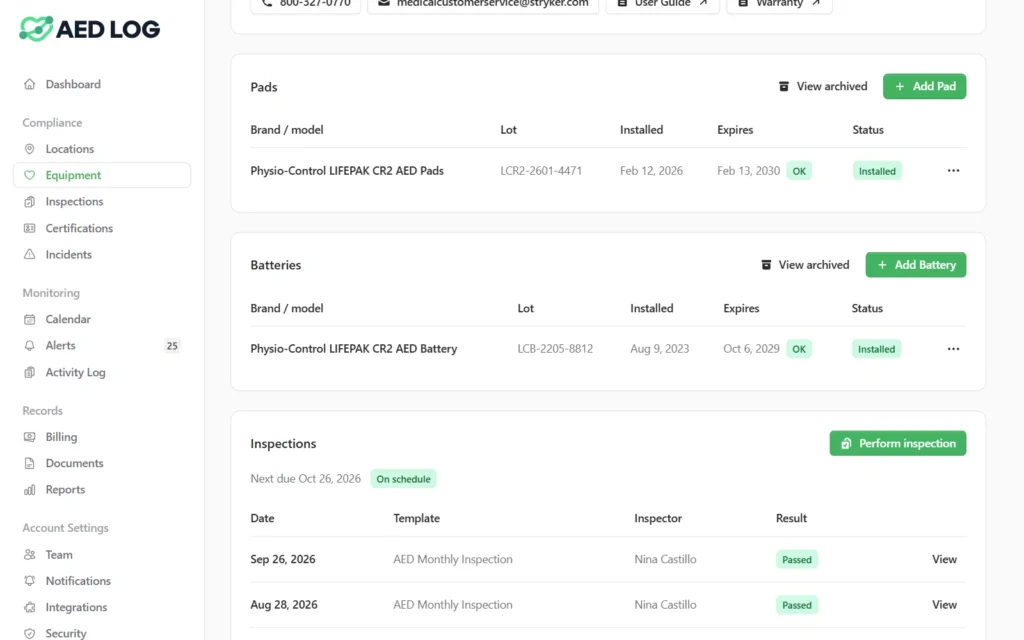
In AED Log you pick the HeartSine samaritan PAD from the built-in catalog, record its pads and battery with their lot numbers and dates, and get a warning before either expires, plus a monthly inspection reminder.
Each pad set and battery is its own record with its own expiration date, so a Pad-Pak never lapses unnoticed. Choose the part from the catalog and its shelf life fills in the expiration date for you; you can always type the date printed on the package instead. Alerts go out by email, Slack, Teams or Discord to the people responsible for that site, and the monthly inspection checklist asks about the status indicator, the pads and the battery. See pad and battery expiration tracking and AED management for more, or see every AED model.
HeartSine samaritan PAD FAQ
How long do HeartSine samaritan PAD pads last?
The adult Pad-Pak (PAD-PAK-01) is good for 4 years after it's made, and its expiration date is printed on the back. Stryker doesn't state a shelf life for the Pediatric-Pak, so go by its printed date. Replace either one after any use.
How long does the HeartSine samaritan PAD battery last?
The battery is inside the Pad-Pak, so it lasts as long as the Pad-Pak does: 4 years from manufacture for the adult Pad-Pak. A new one gives more than 60 shocks, and there's no other battery to order or keep track of.
Can you use the HeartSine samaritan PAD on a child?
Yes. For a child aged 1 to 8, or weighing up to 55 lb (25 kg), use the pink Pediatric-Pak (PAD-PAK-02), which limits each shock to 50 joules. If none is available, HeartSine says to use the adult Pad-Pak rather than wait.
Do you need a prescription for the HeartSine samaritan PAD?
In the US, the 350P is sold without a prescription. The 360P and 450P need one: federal law limits their sale to physicians or buyers with a physician's order.
What's the difference between the HeartSine 350P, 360P and 450P?
The 350P is semi-automatic, the 360P shocks by itself after a spoken countdown, and the 450P is semi-automatic with CPR Rate Advisor feedback. All 3 use the same Pad-Pak and Pediatric-Pak.