

Avive Connect AED part numbers and shelf life
The pad cartridge is the only part an Avive Connect AED owner replaces. The battery is built in and recharged, not swapped.
| Part | Part number | Shelf life | Replace |
|---|---|---|---|
| Avive AED Pad Cartridge Adults and children (Child button); single use | ACC01 | 3.5 years (use-by date on the cartridge) | By the use-by date, after any use, or if the pad seal is opened |
ACC01 is the item number on Avive's online store; the owner's manuals print no part number for the cartridge.
Avive Connect AED self-test and status indicator
The Avive tests itself every day, every week and every month, and the Connect module can report how it's doing over Wi-Fi or cellular. Green blinks on the status light mean it's ready; red blinks or beeps mean something needs fixing.
The daily test checks the battery level, the circuits and whether the pads are ready. The weekly test adds a partial-energy charge and discharge, and the monthly test a full-energy one. The Connect module also checks its own hardware every day; a failure there brings up a notice on the screen but doesn't affect the AED's ability to shock. For a check on demand, press and keep holding the Power button for 5 seconds; the AED then reports its status out loud.
Green blinks mean ready. Red blinks or beeps point to a problem: a low battery, a cartridge that is expired, used, missing or a training cartridge, a storage temperature outside the limits, or a failed self-test. The blink rhythm also tells you about charging: 1 blink a second while it charges, a double blink every 10 seconds once it's full, and 1 blink every 15 seconds when it's unplugged. On the Connect screen, icons show Wi-Fi, cellular, location and both batteries.
If the indicator ever shows a problem, our guide to AED self-test failures and status lights covers what to do first.
Avive Connect AED maintenance checklist
Avive asks owners to check the AED's status regularly, at the status light or through Avive's connected products. In practice that means a charged AED, an in-date cartridge fitted and storage at room temperature.
- The status light blinks green, and the AED isn't blinking red or beeping.
- The Connect screen, or Avive's REALConnect platform, shows no notice about the AED, the cartridge or either battery.
- A pad cartridge, not a training cartridge, is fitted, and the use-by date on its back hasn't passed.
- The AED is charged; Avive suggests keeping it plugged into its charger.
- It's stored clean and dry at 41 to 104°F (5 to 40°C), out of direct sunlight. After time outside 32 to 122°F (0 to 50°C), give it 24 hours at room temperature.
- Rescue supplies, such as gloves and a CPR mask, are with the AED.
After the Avive Connect AED is used
- Let the AED reach Wi-Fi or cellular so it can send the rescue data to Avive.
- Replace the used pad cartridge with a new, in-date one.
- Recharge the AED with Avive's adapter and cable.
Print our free AED inspection checklist to record each check, or read the full AED maintenance guide.
Avive Connect AED recalls
The FDA's recall database showed no recall of the Avive AED, the Avive Connect AED or its pad cartridge when we checked in October 2026.
We found no FDA recall of the Avive Connect AED or its pads and batteries in the FDA’s Medical Device Recall database when we last checked, on October 12, 2026.
Every AED recall, by manufacturer, is on our AED recall list.
How AED Log tracks the Avive Connect AED
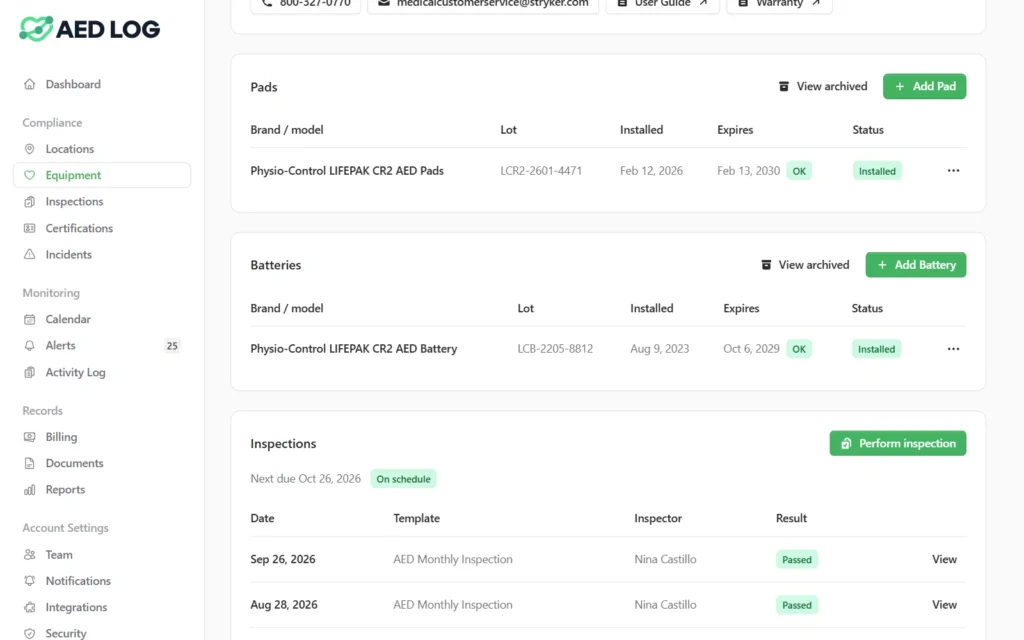
In AED Log you pick the Avive Connect AED from the built-in catalog, record its pads and battery with their lot numbers and dates, and get a warning before either expires, plus a monthly inspection reminder.
Each pad set and battery is its own record with its own expiration date, so a pad cartridge never lapses unnoticed. Choose the part from the catalog and its shelf life fills in the expiration date for you; you can always type the date printed on the package instead. Alerts go out by email, Slack, Teams or Discord to the people responsible for that site, and the monthly inspection checklist asks about the status indicator, the pads and the battery. See pad and battery expiration tracking and AED management for more, or see every AED model.
Avive Connect AED FAQ
How long do Avive Connect AED pads last?
Avive's spec sheet lists a 3.5-year shelf life for the pad cartridge. Replace it by the use-by date on the back of the cartridge, after any use, or if the sealed pads have been opened. The AED won't block an expired cartridge.
How long does the Avive Connect AED battery last?
The battery is built in and recharged, not replaced. Fully charged, it can stand by for up to 12 months or deliver about 75 shocks. Avive suggests keeping the AED on its charger at room temperature; a full charge takes 12 hours.
Can you use the Avive Connect AED on a child?
Yes, for patients older than 1, with the same pad cartridge. Press the Child button for a child younger than 8 or lighter than 55 lb; the AED confirms Child Mode and gives 50 joules instead of 150. It always starts in Adult Mode.
Can you replace the battery in an Avive Connect AED?
No. The lithium-ion battery is built in, and Avive says owners can't replace it. You recharge it through the USB-C port with Avive's adapter and cable, which also charges the Connect module's own battery.
How does the Avive Connect AED report that it's ready?
On the unit, a blinking green status light means ready. The Connect module also sends its status over Wi-Fi or LTE-M cellular to Avive's REALConnect cloud platform, which tracks its location too.