

What the cardiac emergency response plan covers
A cardiac emergency response plan (CERP) says who responds to a sudden cardiac arrest, what each person does, where the AEDs are and how they’re kept ready, and how the plan is practiced and reviewed. This template follows the American Heart Association’s core elements.
A workplace may also need a broader emergency action plan for fires and evacuations under OSHA’s 29 CFR 1910.38; our free emergency action plan template covers that, and this plan handles the cardiac emergency in detail.
The AHA’s cardiac emergency response plan checklist for schools lists the minimum steps a plan should include. In plain words:
- Build the plan and the team: write the plan and name a cardiac emergency response team.
- Share it and connect it to local responders: distribute it, post it, and tie it to local EMS, fire and police.
- Place and maintain AEDs on a routine schedule, as you would fire extinguishers.
- Keep staff trained in first aid, CPR and AED use.
- Teach CPR widely, including Hands-Only CPR.
- Drill the plan, like fire and lockdown drills.
- Activate the team when a cardiac arrest happens.
- Review the plan every year, and debrief right after any event.
The template has a section for each, apart from teaching CPR to everyone, which is a training program of its own.
The cardiac emergency response plan template
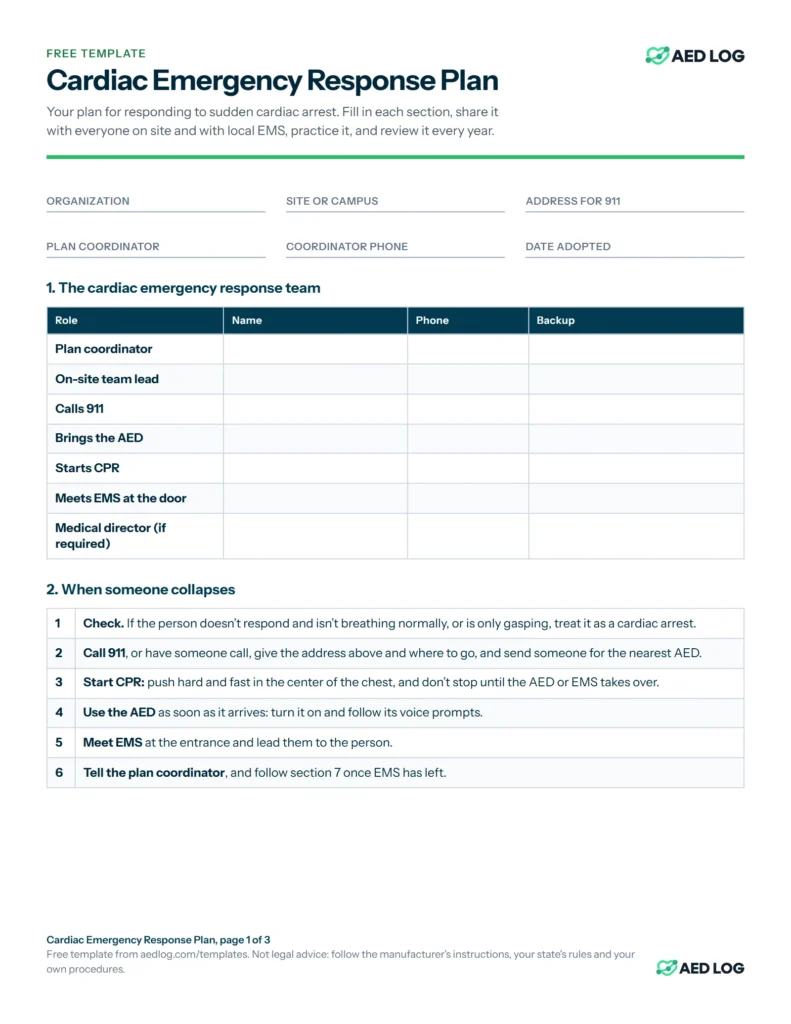
The PDF has eight sections over three pages. You fill them in by hand, share the finished plan, and keep it with your AED records.
- The response team: the plan coordinator, the on-site lead, and who calls 911, brings the AED, starts CPR and meets EMS, each with a backup.
- When someone collapses: six steps, from recognizing a cardiac arrest to handing over to EMS.
- AED locations and upkeep: each AED’s exact location, model, serial number and pad and battery dates.
- Training: each responder’s course and card expiration date.
- Sharing the plan and working with EMS: who has the plan, where it’s posted, and when EMS was told where your AEDs are.
- Drills: date, scenario and how long it took to get an AED to the scene.
- After a cardiac emergency: replacing pads, restocking, reporting the use where required, and debriefing.
- Yearly review: who reviewed it, what changed, and sign-off.
Some states require an AED program to be written down. The AED law data in AED Log lists 12 states that require written program documentation and 40 that require a school cardiac emergency response plan.
Adapting the plan for schools and Desha’s Law
Schools need a plan that covers every building and every school-sponsored event, including athletics. In New York, Desha’s Law makes a cardiac emergency response plan part of each district-wide school safety plan.
Desha’s Law was signed on July 24, 2025, as Chapter 189 of the Laws of 2025, and its main provisions took effect on January 20, 2026. Under it, a district’s plan has to cover:
- the people who respond to a cardiac arrest anywhere on school grounds or at school-sponsored events, including all athletics;
- procedures for each venue of athletic practices and events;
- nationally recognized, evidence-based core elements, such as the American Heart Association’s; and
- how the plan fits with community EMS.
It also requires AEDs in each instructional facility to be clearly marked, accessible and maintained. To adapt this template for a school, fill in one copy per building, add a row to the response team for each athletic venue, and list the coaches and athletic trainers in the training table. See Desha’s Law and AED management for schools.
How to use the template
Name the team, fill in your AEDs and responders, share the plan with everyone and with local EMS, run a drill, and review it every year.
- Name a coordinator who owns the plan, and fill in the response team with a backup for every role.
- List every AED with its exact location and its pad and battery dates. Our AED placement guide helps you check you have enough.
- List your trained responders and when their cards expire.
- Share the plan with all staff, post it, and tell local EMS where your AEDs are.
- Run a drill and time how long it takes to get an AED to the scene.
- Review it every year, and after every real event.
Starting from scratch? Read how to start an AED program first.
Track the AED side of the plan automatically
The plan is yours to write. AED Log keeps the parts of it that change every month up to date: AED inspections, pad and battery dates, responders’ certifications and incident reports.
- Monthly AED inspections with reminders, and alerts when a check fails.
- Pad and battery expiration dates, with warnings before they pass.
- Every responder’s CPR and AED certification, with a warning before it expires.
- Incident reports after an AED is used, and a document library for the signed plan.
See AED Log’s features, or what AED program management involves.